Treading Water

Ulli Uncategorized Contact

As is usually the case, when milestone levels are broken, the markets took a pause yesterday as mixed news did not provide enough of an impetus for the bulls to drive the major indexes higher.

As the chart above shows (courtesy of marketwatch.com), the S&P; 500 trended within a five point range and closed slightly lower.

Some contributing factors to the sideways activity were violent outbursts in Egypt and miserable weather conditions in parts of the U.S. Nevertheless, the markets remained fairly resilient despite no shortage of opinions that a major correction is about to occur.

ADPs announcement of strong private sector growth was taken in stride as those numbers (187,000 jobs added in January), have not been an accurate reflection in the past as to how Friday’s unemployment report will turn out.

Party Time On Wall Street

Ulli Uncategorized Contact


It was party time on Wall Street yesterday as both, the Dow and the S&P; 500, cleared their respective milestone hurdles of 12,000 and 1,300 by a solid margin.

Setting off the move past the resistance levels was a report indicating that U.S. manufacturing is showing the most strength since 2004. Helping matters was the fact that Egypt remained fairly quiet and that the traffic along the important key waterways was flowing normally.

This was encouraging news in that it alleviated fears that global economic activity won’t be interrupted—at least not for the time being. Markets around the world participated in yesterday’s rally and most asset classes were higher with the exception of bonds, which fell due to rising interest rates.

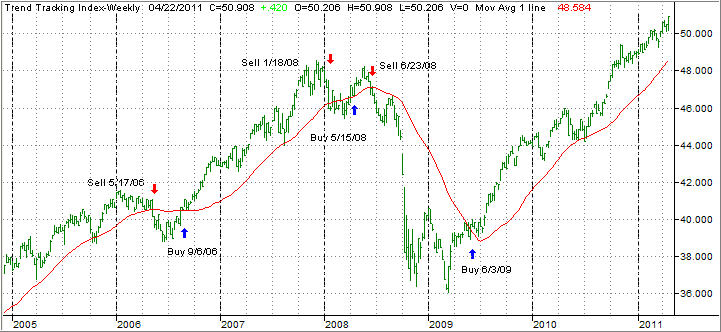
The S&P; 500 closed at 1,308, its best finish since June 25, 2008, just two days after our domestic sell signal effective June 23, 2008. In other words, if, as a buy and hold investor, your portfolio tracked the performance of the S&P; 500, you will now have almost reached the breakeven point…

The market will face some headwinds today in form of the ADP National Employment Index and a report on layoffs. Maybe yesterday’s euphoria can carry us through these numbers as well, should they not turn out to be as anticipated.

Leaving Friday’s Losses Behind

Ulli Uncategorized Contact

Yesterday, the markets looked past the turmoil in Egypt and recouped a good chunk of Friday’s losses.

Supplying the initial boost were a couple of takeover announcements and better-than-expected earnings from Exxon Mobil. Further helping the upside cause were two economic reports showing that the recovery maybe gaining steam.

Consumer spending rose more than forecast as purchases, which account for 70% of economic activity, climbed for the second consecutive month in a row. Additionally, another report showed that businesses expanded at the fastest rate in two decades according to the Institute for Supply Management.

Gold lost and interest rates rose. Nevertheless, the markets managed to close up in January, which can bode well for the rest of this year.

According to the Stock Trader’s Almanac, a rise in January has resulted in gains for the rest of the year 90% of the time since 1950. While these are good odds, it does not say anything about the magnitude of the gains. So we’ll have to wait another 11 months to find out for sure if this will be an odds defying year or not.

Reader Q+A: Re-entering A Position After Getting Stopped Out

Ulli Uncategorized Contact

Here’s a reader question that comes up on a regular basis:

As an employee of the xx company, I manage my Federal Thrift Savings Plan. If I get stopped out, what rules should I use to re-enter the market? I know you must get this question a couple of times a week but I couldn’t find the answer in your past postings.

Re-entering after having experienced a whipsaw signal is always a challenging task. There are no hard and fast rules and much depends on the individual’s risk tolerance. I can suggest several scenarios for you.

Let’s assume the high price a fund has reached, since you bought it, is $10, and the market starts to decline. If you apply the 7% sell stop rule (for domestic and international funds/ETFs), you should be pulling the trigger once the fund breaks through a price point, on a closing basis, of 9.30 or thereabouts.

You now have 3 options:

1. You can replace this fund with another one that is currently in an uptrend

2. If you are conservative, you can repurchase this fund once it takes out its old high of $10. That presumably would tell you that the uptrend has resumed, but, depending on market activity, it can be a long way back to reach that point.

3. If you are more aggressive and want to re-enter sooner, pick a price that is 2% above the 9.30 level you got stopped out of. That will get you in the market sooner, but it also can set you up for another whipsaw if this trend reversal does not hold.

As I said, there is no perfect way, and you can use any other percentage that you are more comfortable with. The only thing I recommend is that, once you have decided on that re-entry number be consistent with it.

Sunday Musings: Clarification On Sell Stops And Distributions

Ulli Uncategorized Contact

Whenever markets correct and sell stops get triggered, there seems to be some confusion as whether the intended sell stop kicked in at the right time.

Reader Paul was wondering about that with regards to the last Friday’s sell of BRF. He wanted to know why I waited until the fund had dropped 18% off its high before selling it.

Did I really wait too long or did Paul not look at all the numbers? Here’s his matrix on the purchases and sales:


[double click to enlarge]

As you can see, Paul bought BRF on 9/14/10, after which it made a high of 63.73 and it was sold on 1/28/11 at 51.70 for a loss of -6.51%.

These are Paul’s figures, but are they correct?

No, because he forgot the most important part, which is that BRF had a huge distribution of $3.575 o 12/23/10. As I have posted many times, the high price needs to be adjusted down to correctly establish a new high point; in this case the new high would be 60.16.

Just as important is the fact that distributions affect the return as well. Here’s the updated matrix:

[double click to enlarge]

As you can see, this transaction just about broke even since the capital loss was just about offset by the distribution.

BRF corrected sharply and had come off its high by about 14% before we were able to liquidate it. That happens sometimes when markets get very volatile as we saw last week.

However, it is important to remember to always adjust for dividends/distributions if they occurred during the period you owned a fund/ETF; otherwise your numbers may be way off base and won’t give you an accurate picture of what happened.

As an aside, just glancing at returns provided by your brokerage firm statements will also not give you a completed view, since distributions are not included.

Looking At The Wrong Numbers

Ulli Uncategorized Contact

A few days ago, I ran into an old friend who enthusiastically greeted me with “Wow, did you see the Dow crossing the 12,000 level? My portfolio is now within 5% of what it was 3 years ago!”

That seems to be theme of the news media these days as you’re being bombarded with statements like the S&P; 500 has risen 92% from the March 9, 2009 lows.

As if you are supposed to have bought stocks on that infamous date while feeling like a loser if you didn’t make 92%. All this rebound has done is bailed out the buy and hold crowd.

Remember the simple math fact that states that if you lose 50% of your portfolio value, you have to make 100% just to get to the breakeven point? This is exactly what happened in 2008; most investors saw their portfolios drop some 50% and they are now getting close to a breakeven point, just as my friend Mike mentioned above.

Mike’s quick reference matches my numbers as well. You may remember that our domestic sell signal kicked in effective June 23, 2008 with the S&P; 500 being at the 1,318 level. It’s currently just below the 1,300 mark and needs to gain another 1.65% just to get to the 2008 level we sold at.

In other words, simply looking at the rebound after the market crash is not seeing the big picture. You need to factor in what happened before March 9, 2009, in order to see that the last 2 years did not really produce any portfolio gains; it was simply time spent making up losses.

It’s hard to believe but, if you had sold along with us on June 23, 2008 and never reentered the market again, you’d be still ahead of those claiming of having made 92% off the March 09 lows.