ETFs/Mutual Funds On The Cutline – Updated Through 2/3/2012

Ulli ETFs on the Cutline Contact

Below are the latest ETF Cutline reports, which show how far above or below their respective long-term trend lines (39 week SMA) my currently tracked ETFs/MFs are positioned.

The first report covers the ETF Master List from Thursday’s StatSheet and includes 398 ETFs, of which currently 340 (last week 293) of them are hovering in bullish territory.

The second report includes only High Volume ETFs. To clarify, High Volume (HV) ETFs are defined as those with an average daily volume of $10 million or higher.

These ETFs are generated from my selected list of some 93 that I use in my advisor practice. It cuts out the “noise,” which simply means it eliminates those ETFs that I would never buy because of their volume limitations. 72 ETFs (last week 59) have managed to move into in bullish territory after the recent run up.

The third report covers Mutual Funds on the Cutline. There are currently 774 (last week 681) above the line and 87 below it out of the 861 that I follow.

Take a look:

1. ETF Master Cutline Report

2. ETF High Volume Cutline Report

3. MF Cutline Report     

Last Week In Review: ETF News And Blog Posts To 2/5/2012

Ulli Market Review Contact

In case you missed it, here’s a summary of the ETF topics and market reviews I posted to my blog during the week ending on 2/5/2012.

In a reversal from the prior week, upward momentum gained steam as a better than expected jobs report pushed the major indexes higher while gold finally pulled back.

The Greek soap opera continued in full swing, but the domestic markets were largely unaffected as a hard default is now fully expected. Even our International Trend Tracking Index (TTI) crossed its trend line to the upside and, barring any major pullback, I expect to announce a new ‘Buy’ in that arena within a couple of trading days.

This week, we covered the following:

Read More

A Drop In ETF Trading Volume

Ulli Market Review Contact

While Europe is falling apart, it’s interesting to see how trading volume has been affected. Undoubtedly, there can be major fluctuations in ETF inflows and outflows depending on investor risk appetite

In this discussion, ETF trading volume is analyzed, noting that volume in the U.S. has hit a low not seen since 2007. As we’ve witnessed, there has been lower volatility in markets as of late with hedge funds possibly pulling back in their usage of ETFs. Furthermore, there’s a question of what effect financial regulation has had on ETF trading.

On one hand, we’ve seen investors flock toward Treasuries because although volatility isn’t high, risk certainly is. It’s possible that investors are using direct fixed income instruments rather than fixed income ETFs to reduce their risk exposure. However, continued upward momentum might prompt investors to increase their equity allocation via ETFs.

Although it might be tempting to pick individual stocks during a short-term upswing with the hopes of choosing a home run winner, ETFs offer the necessary diversification within an asset class during high risk periods such as now.

02-05-2012

Ulli Newsletter Archives Contact

The ETF/No Load Fund Tracker—Monthly Review—January 31, 2011

A Hot January For Equity ETFs

While 2011 didn’t offer much hope for investors, 2012 got off to an unexpectedly great start with U.S. major market ETFs leading the way, gaining significant traction to move further into bull territory. The S&P 500 gained over 4% for the month to have its best January since 1997 while other indices also performed well.

Nevertheless, the main focus is on developments in Europe, especially as they pertain to Greece.

Negotiations between Greek leaders and bondholders leaders seem to have no end, putting its March bailout payment in jeopardy. By the end of January, a 70 percent haircut was considered although bondholders are pushing for new 30-year bonds with a favorable interest rate, causing further consternation. With the IMF and others also throwing their two cents in on conditions of the potential deal, it’s a messy stew with too many chefs.

Not only is Greece feeling the heat, but Portugal is heading down a dark road. With bond yields tipping over 17% and a debt-to-GDP ratio approaching 120%, Portugal might soon find itself in Greek shoes.

If Portugal can’t restore investor confidence and successfully implement austerity measures, it will have to restructure its debt, causing further strain on Europe’s already limited funding capacity. Although the Eurozone can arguably bail out Greece and Portugal, this is simply out of the question for Spain and Italy, whose combined debt nears $4 trillion.

Although Europe is falling apart, solid upward momentum, especially during the first few trading days of 2012, has prompted me to add some additional equity/sector ETF exposure in addition to bond ETFs. This brings us to an invested level of roughly 90%, depending on portfolio size.

Given Europe’s continued lack of progress in solving the debt crisis, my goal is mimic our ETF Model Portfolio #2 since it is more conservative with a 40% holding in bond ETFs. Treasury Inflation Protected Securities (TIPS) are particularly attractive since they outperformed the S&P 500 during a sluggish 2011. With holdings in Vanguard Total Bond Market ETF (BND) and Vanguard Short-Term Bond ETF (BSV), we have positioned ourselves to absorb any potential negative shocks to our equity ETF allocation possibly due to European uncertainty.

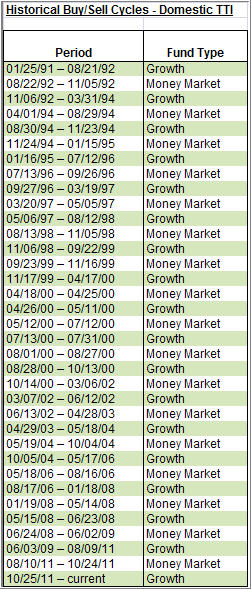
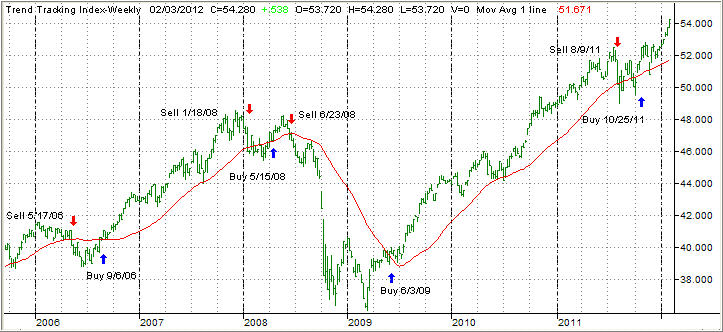
As far as our equity exposure is concerned, we have added some new equity ETF names to take advantage of the upside. Our Domestic TTI remained in bull territory over 4% as the chart below shows:

For instance, we have replaced Vanguard Total Stock Market ETF (VTI) with iShares Dow Jones Select Dividend (DVY), which yields 3.44% and has held up better during market corrections. Some REIT exposure via Vanguard REIT Index ETF (VNQ) has been a good choice for us, as there have been some solid positive jumps. Also, one of our mainstay holdings, Consumer Staples Select Sector SPDR (XLP), has been on an upswing.

Despite positive trends stateside, the international sphere isn’t as inviting for equity exposure. Although the International TTI is now barely in the green, I am hesitant to add international ETF exposure until I see a prolonged upward shift. The International TTI’s position relative to its long-term trend line greatly improved over the course of January, but my current preference is to add a country ETF, a small gold position, or possibly both. While gold took a dive during the second half of 2011, it has rebounded nicely as the uncertainties in Europe have not disappeared.

All in all, Europe remains front and center as the situation appears to be worsening by the day. Futile attempts by incompetent politicians to offer endless band aid approaches are causing me to remain conservative in my investment stance. That includes having my trailing sell stops ready to be executed should the markets dictate that it is in our best interest to do so.

Golden Cross Vs. Death Cross – Are These Meaningful Technical Indicators?

Ulli Market Review Contact

Europe is falling apart but the S&P 500 is having its best start to the year since 1989. I’m sure you are puzzled as to why equities have gone full steam ahead despite less than stellar fundamentals. While I believe this recent run-up will not last in the long-run, there are indicators that might suggest otherwise. Perhaps the answer as to where we’re going lies in the technicals.

The crossing of 50-day and 200-day moving averages is a key buy and sell trigger for some technical analysts. The Golden Cross is when the 50-day moving average crosses above the 200-day moving average, thereby generating a buy signal. Conversely, the Death Cross occurs when the 50-day moving average crosses below the 200-day moving average, resulting in a sell signal.

Seeing as a Golden Cross just happened this past Tuesday (January 31), does that mean we should go into major buy mode? Let’s get at the devil in the details.

Read More

02-03-2012

Ulli Newsletter Archives Contact

ETF/No Load Fund Tracker Newsletter For Friday, February 3, 2012

ETF/No Load Fund Tracker StatSheet

————————————————————-

THE LINK TO OUR CURRENT ETF/MUTUAL FUND STATSHEET IS:

https://theetfbully.com/2012/02/weekly-statsheet-for-the-etfno-load-fund-tracker-newsletter-updated-through-02022012/

————————————————————

Market Commentary

Friday, February 3, 2012

BULLS KEEP ROARING FOR DOMESTIC ETFS

Markets continued their upward trajectory, pushing more into bull territory. The S&P 500 jumped 1.46% while the NASDAQ rose 1.61% to hit its highest level since December 2000. The optimism was also shared by European and Asian indices.

More evidence of pendulum behavior in Treasury yields, the 10-year Treasury shot up to 1.95%. Like I’ve said before, although volatility has largely been absent lately, we are in a relatively risky investment environment considering what’s going on in Europe.

In the major news of the day, U.S. unemployment fell to 8.3% in January, the lowest level since February 2009. Nevertheless, there was a decrease in labor force participation, although the Bureau of Labor Statistics says that this is due to population growth among the elderly and young who have lower rates of labor force participation (see page 6 of this). While there’s still a long way to go on the employment front, it’s definitely an encouraging sign.

On the international stage, it looks like Greece might be coming to a close on talks with its creditors. Nonetheless, labor reform is the contentious issue as various parties are putting pressure on Greece to institute wage and pension cuts.

To make things worse, debt inspectors say that Greece may require additional funds on the order of roughly $20 billion just to bring its debt-to GDP ratio down to 120%. As the clock ticks for Greece to obtain approval for a second bailout package, I can only wonder if the Greeks will agree to a new deal, and if so, whether it can get itself back on the financial straight and narrow or end up being debt slaves to the European banks forever.

A sign that economic weakness in the Eurozone persists, December retail sales were down 0.4% in the region despite the fact that it was the holiday season. Markets might be responding positively at the moment, but the real economy continues to suffer.

While our Domestic TTI remains in positive territory by a solid +5.21%, the International TTI finally broke above its trend line by +2.48%. While the International TTI is now positive, I’m not yet comfortable issuing a buy signal for international ETFs, as I want to see a little more stability over the coming few trading days.

The picture is still gloomy internationally and not much better in the U.S. But given recent trends, we have to participate on some of this upside while being prepared for a negative shock by using our trailing stop loss points.

Have a great week.

Ulli…

————————————————————-

READER Q & A FOR THE WEEK

All Reader Q & A’s are listed at our web site!
Check it out at:

http://www.successful-investment.com/q&a.php

A note from reader Don:

Q: Ulli: I am sitting with a nice profit with VEU and VNQ. 8-10% range. With the market widely fluctuating, at what point would one consider taking profits and buying back later?

I hate to see this disappear by having a 7% trailing stop should the market go down. I realize there may not be a perfect answer to this. Thanks for the excellent site.

A: Don: You are right, there is no perfect answer. My preference is to use trailing sell stops as my signal when to take profits or limit losses, whichever case it may be. If you’re happy with your current gains and are worried about giving them back, simply take them.

———————————————————-

WOULD YOU LIKE TO HAVE YOUR INVESTMENTS PROFESSIONALLY MANAGED?

Do you have the time to follow our investment plans yourself? If you are a busy professional who would like to have his portfolio managed using our methodology, please contact me directly or get more details at:

https://theetfbully.com/personal-investment-management/

———————————————————

Back issues of the ETF/No Load Fund Tracker are available on the web at:

https://theetfbully.com/newsletter-archives/