Can Equities Do Well Even If QE Generates Too Much Inflation?

Ulli Market Commentary Contact

Bill Gross of PIMCO thinks Treasuries and high-yield bonds will do well as investor become risk averse, which is a reasonable bet, says David Zervos, Head of Global Fixed Income Strategy at Jefferies.

Gross probably believes quantitative easing does little good for the real economy and that’s where the subtle difference of opinion lies, he added. In the end, the equity market is going to do well even if quantitative easing generated too much of inflation and not enough of real growth.

For the equity market, it doesn’t matter whether the Fed gets its move right and gets investors take more risk to generate real returns on real capital because higher inflation will drive equities higher which can be used as a hedge against inflation.

For bonds it becomes a little tricky when there’s excess inflation in the future as returns take a hit.

Should investors avoid assets that can be diluted through money printing like bonds and focus more on those that can’t be diluted? David said there are two types of asset classes in the world, those that can be printed and those that can’t be printed. Assets like bank accounts, T-bills and cash get diluted as the Fed prints more money to buy mortgage-backed securities.

Read More

New ETFs On The Block: Vanguard Short-Term Inflation Protected Securities Index Fund (VTIP)

Ulli Inflation ETFs Contact

Vanguard, the Wayne, Pennsylvania-based leader of low-cost equity-linked exchange-traded funds has launched the Vanguard Short-Term Inflation Protected Securities Index Fund (VTIP) as the firm continues to expand its offerings in the fixed-income asset class. This is the firm’s first product that focuses on the short-term TIPS market.

Treasury Inflation Protected Securities (TIPS) have evoked much interest among a wide range of investors and is particularly popular among those who seek to invest in fixed-income securities that offer some protection against rising prices, a legitimate concern after years of liquidity injection (i.e. quantitative easing) by central banks across the world.

VTIP targets the short-end of the TIPS curve and invests in securities that have a maturity of five years or less with an aim to achieve inflation-adjusted real returns and capital preservation. Since the short-end of the yield curve shows less price fluctuation against inflation, the fund can be expected to have lower volatility and lesser real interest-rate risk than traditional long-maturity TIPS funds.

Read More

10-19-2012

Ulli Newsletter Archives Contact

ETF/No Load Fund Tracker Newsletter For Friday, October 19, 2012

ETF/No Load Fund Tracker StatSheet

————————————————————-

THE LINK TO OUR CURRENT ETF/MUTUAL FUND STATSHEET IS:

https://theetfbully.com/2012/10/weekly-statsheet-for-the-etfno-load-fund-tracker-newsletter-updated-through-10182012/

————————————————————

Market Commentary

Friday, October 19, 2012

MAJOR MARKET ETFS LOG BIGGEST DECLINE IN FOUR MONTHS OVER WEAK EARNINGS; IS ANOTHER CRASH LURKING ON THE HORIZON?

On the 25th anniversary of the 1987 market crash, the major indexes dropped sharply causing fears of a repeat performance. In the bigger scheme of things, the S&P 500’s 1.67% retreat was fairly benign when considering the elevated level this index has been occupying especially in view of the fact that underlying fundamentals are totally out of sync.

While the markets managed to avoid a disaster, it does not mean one is not lurking on the horizon. To me, it’s a sure thing that major pullback will happen, but the timing of it is the great unknown, however, having lived through the 1987 market debacle, I can share some experiences with you.

1987 was the year when I designed the Trend Tracking Indexes (TTIs), of which my main focus had been the domestic version. It held up well during the 10/19/87 massacre by having generated a ‘Sell’ signal for all equity funds 2 days prior to the event.

Since then we have seen our share of market crashes, wars, and other disasters around the world. Here’s what I have found: While market pullbacks can occur at any time, true market crashes, such as in 1987, 2000 and 2008, just to name a few, have only occurred when the Domestic TTI was positioned below its long term trend line.

Think about this for a moment. Markets simply don’t crash off their highs, according to my observations; they slowly retreat, bob and weave for a while, after which downward momentum accelerates, first slowly, as major trend lines are breached to the downside, and then with increased speed.

This is how it has played out for the past 25 years. Now, this does not mean, that a sudden crash can’t happen, I am merely pointing out that the odds are very low. Today’s downdraft has pulled the Domestic TTI closer to its long-term trend line, so I would expect if downward momentum accelerates further that our trend line break will occur before massive downside damage.

It’s therefore important that you stay tuned to the latest updates as in this era of market domination by the Fed, along with High Frequency Trading, anything can happen with lightening speed. As usual, should a breakdown occur, most investors won’t believe it until it’s too late; so be prepared and have your sell stop points in order should the need for execution arise.

In today’s news, a report by the National Association of Realtors showed sales of existing homes dropped 1.7 percent in September from a 7.8 percent rise in August. The reading was in line with expectations as supply of homes also declined. The inventory of previously owned and new homes combined fell to 2.4 million units, the lowest since July 2002.

Outside the US, the European debt crisis continued to drag on as the two-day long EU Summit in Brussels ended without any mention of aid to Spain. No surprise there.

Moreover, German Chancellor Angela Merkel sounded skeptical over the end of 2012 deadline to set up a euro-wide banking regulator. The European Central Bank is set to become the eurozone’s main financial supervisor and could cover about 6,000 banks from January 1, paving the way for direct lending to Spanish banks.

The Dow Jones Industrial Average (DJIA) retreated 205 points, managing to cling to a slim 0.1 percent weekly gain. Breadth within the 30-component blue-chip index turned overly negative with all but one stock finishing lower.

The S&P 500 Index (SPX) trimmed 24 points with consumer discretionary and basic materials taking the biggest hit and all of its 10 business groups finishing lower. The index is up 0.32 percent for the week despite Friday’s 1.7 percent plunge.

Treasury securities advanced after the 10-year benchmark yield dropped to the lowest level in six weeks as growing uncertainty in Europe stoked demand for safer assets. The 10-year Treasury yield dropped seven basis points to 1.77 percent while 30-year Treasury bond yields tripped seven basis points as well to 3.01 percent.

The US dollar advanced Friday after disappointing earnings, guidance or revenue from household names, particularly in the tech sector, soured risk sentiment.

Led by banks, European stocks declined amid earnings woes and an inconclusive EU Summit that failed to provide any direction to the ongoing credit crisis. The pan-European Stoxx Europe 600 index tumbled 0.8 percent, still managing a decent 1.7 percent gain for the week.

The Spanish IBEX 35 index tumbled 2.3 percent, dragged down by Banco popular Espanol and Banco Santander SA as European leaders failed to mention any progress over Spain’s formal bailout request.

In Frankfurt, the DAX 30 index fell 0.8 percent, but finished the week 2.1 percent higher. Commerzbank AG crashed 5.3 percent while Deutsche Bank shaved 3.7 percent.

In the ETF space, nearly all sectors barring bonds closed lower. Commodities took the biggest hit with precious metals and base metals like copper sinking the most. The Barclays iPath DJ-UBS Copper Total Return Sub-Index ETN (JJC) was one of the biggest percentage decliners, shedding 2.73 percent on the day.

Crude oil futures also took a deep dive, losing 2.13 percent to end at $90.05 a barrel. The United States Oil Fund slipped 2.14 percent to finish at $33.34 a share.

This week was a tale of two stories, as our Domestic Trend Tracking Index (TTI) dropped while its international cousin rose.

Since the European markets were closed already as today’s downward momentum accelerated, we may see some delayed fallout in that arena on Monday. Here’s how we ended up:

Domestic TTI: +1.69% (last week +2.23%)

International TTI: +4.03% (last week +2.51%)

Have a great week.

Ulli…

Disclosure: No holdings in the ETFs discussed above

————————————————————-

READER Q & A FOR THE WEEK

All Reader Q & A’s are listed at our web site!
Check it out at:

http://www.successful-investment.com/q&a.php

A note from reader Ken:

Q: Ulli: Do you calculate the Trend Tracking Index (TTI) on a daily basis or is it just done once per week when you post the Stat Sheet? If it is calculated daily, is there somewhere on your website where it is posted?

Thanks for your good work. I find it very useful as confirmation or not vs. my own work and analysis.

A: Ken: Yes, the TTIs get recalculated on a daily basis, but their respective moving averages (M/As) get recalculated only on Friday. So, when I publish Friday’s numbers, they include Friday’s price and the latest M/As.

———————————————————-

WOULD YOU LIKE TO HAVE YOUR INVESTMENTS PROFESSIONALLY MANAGED?

Do you have the time to follow our investment plans yourself? If you are a busy professional who would like to have his portfolio managed using our methodology, please contact me directly or get more details at:

https://theetfbully.com/personal-investment-management/

———————————————————

Back issues of the ETF/No Load Fund Tracker are available on the web at:

https://theetfbully.com/newsletter-archives/

ETF/No Load Fund Tracker Newsletter For Friday, October 19, 2012

Ulli ETF Tracker Contact

ETF/No Load Fund Tracker StatSheet

————————————————————-

THE LINK TO OUR CURRENT ETF/MUTUAL FUND STATSHEET IS:

https://theetfbully.com/2012/10/weekly-statsheet-for-the-etfno-load-fund-tracker-newsletter-updated-through-10182012/

————————————————————

Market Commentary

Friday, October 19, 2012

MAJOR MARKET ETFS LOG BIGGEST DECLINE IN FOUR MONTHS OVER WEAK EARNINGS; IS ANOTHER CRASH LURKING ON THE HORIZON?

On the 25th anniversary of the 1987 market crash, the major indexes dropped sharply causing fears of a repeat performance. In the bigger scheme of things, the S&P 500’s 1.67% retreat was fairly benign when considering the elevated level this index has been occupying especially in view of the fact that underlying fundamentals are totally out of sync.

While the markets managed to avoid a disaster, it does not mean one is not lurking on the horizon. To me, it’s a sure thing that major pullback will happen, but the timing of it is the great unknown, however, having lived through the 1987 market debacle, I can share some experiences with you.

1987 was the year when I designed the Trend Tracking Indexes (TTIs), of which my main focus had been the domestic version. It held up well during the 10/19/87 massacre by having generated a ‘Sell’ signal for all equity funds 2 days prior to the event.

Since then we have seen our share of market crashes, wars, and other disasters around the world. Here’s what I have found: While market pullbacks can occur at any time, true market crashes, such as in 1987, 2000 and 2008, just to name a few, have only occurred when the Domestic TTI was positioned below its long term trend line.

Read More

Weekly StatSheet For The ETF/No Load Fund Tracker Newsletter – Updated Through 10/18/2012

Ulli ETF StatSheet Contact

ETF/Mutual Fund Data updated through Thursday, October 18, 2012

If you are not familiar with some of the terminology used, please see the Glossary of Terms.


1. DOMESTIC EQUITY MUTUAL FUNDS/ETFs: BUY — since 10/25/2011
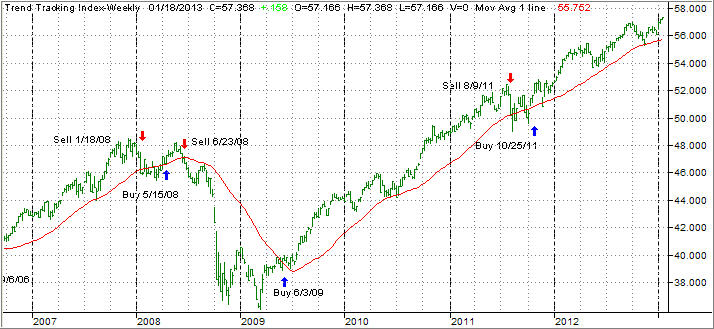
The Domestic TTI (Trend Tracking Index) broke through its long-term trend line generating a Sell for this area effective 8/9/2011. Over the recent past, we’ve seen the TTI hovering slightly below and above this dividing line between bullish and bearish territory. The clear break to the upside occurred on 10/24/11 and, effective 10/25/11, a new Buy signal for domestic equities went into effect.

As of today, our Trend Tracking Index (TTI—green line in above chart) has broken above its long term trend line (red) by +2.46%. A break back below it will generate a Sell signal to move out of all domestic equity positions. Be sure to tune into my blog for the latest updates.
Read More

Jobs Data Disappoints While Google Weighs On Equities; Europe Hits 16-Month High

Ulli Market Commentary Contact

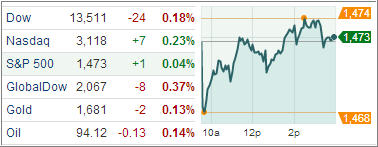
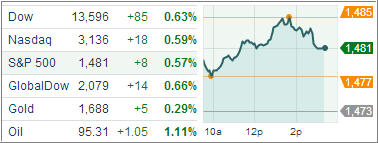
[Chart courtesy of MarketWatch.com]

US stocks turned lower Thursday falling for the first time this week as tech giant Google missed earnings target highlighting the storm brewing in the tech sector while a rise in weekly jobless rate eclipsed upbeat manufacturing data.

The mood went sour after a Labor Department showed initial jobless claims jumped 46,000 to 388,000, reversing a previous report that showed jobless rate tumbled to a four-year low in a seasonal quirk. Equities however, came off session lows after a Federal Reserve Bank of Philadelphia report revealed manufacturing bounced back in October while a separate Conference Board’s index of economic indicators climbed 0.6 percent in September.

Despite some very marginal and some extremely poor earnings reports and other data points, the markets did not head south as much as you might have expected. Why is it that we seem to continuously manage to regain early losses later on in the day?

Read More