The European Central Bank’s Outright Monetary Transaction was opposed by the German Bundesbank on the ground it amounts to refinancing the debts of profligate states.
Critics of Germany often say the Bundestag is erecting hurdles for the creation of the ‘United States of Europe’; i.e. – greater integration among the member states similar to the United States of America.
The key point the critics seem to miss is that even in the US, the Federal Reserve can’t extend credit to highly indebted states, even if they are on the verge of default (like California). Also there’s no provision for debt mutualization or joint liabilities in the US, the latest measure advocated by European Council President Herman Van Rompuy.
Germany will never be out of the negotiations even after the ECB’s OMT announcement though it has technically the same weight as Malta, one vote out of 23, on the Governing Council.
However, when it comes to capital related issues, the German voting share is about 27 percent. Though Germany doesn’t run the show, they will oppose writing the bailout check to the peripheral states in the future, says Willem Buiter, chief economist at Citigroup.
State Street Global Advisors, the Boston-based second largest US provider of exchange traded funds has expanded its offering by two with new funds focused on the S&P 1500 index.
State Street, a major player with over 100 different funds in its portfolio, has nearly quarter of a trillion dollars in assets under management. The latest funds, while tracking the S&P 1500 index, will ‘tilt’ on different aspects such as value and momentum of the component securities makeup – an enhanced-beta strategy that is fast gaining popularity in the world of investment science.
The two new funds, the SPDR S&P 1500 Momentum Tilt ETF (MMTM) and the SPDR S&P 1500 Value Tilt ETF (VLU), target stocks with high momentum and stocks that display value characteristics. With this ‘tilt’ strategy, the funds seek broad market exposure but with a more alpha-seeking approach.
MMTM will track the S&P 1500 Positive momentum Tilt Index and will buy those stocks in the S&P 1500 benchmark that have appreciated in price the most over the past 12 months.
S&P analyses a stock’s price performance over the past 11 months ending one month before the benchmark is rebalanced and goes beyond the traditional capitalization-weighted combination of large-, mid-, and small cap indexes. Currently, the portfolio is tilted towards staples and tech with Apple receiving nearly 8.4 weight and leans away from energy and financials. The fund follows the underlying index through a representative sampling strategy.
US EQUITIES FINISH SESSION UNCHANGED BUT RETREAT FOR THE WEEK; EUROPE PUSHES HIGHER ON US GDP DATA
US equities capped a choppy and sloppy week nearly flat Friday, but extended weekly losses after uninspiring earnings reports failed to offset investor concerns about a global slowdown and post-election uncertainties.
Gross Domestic Product, the broadest gauge of economic activity, expanded at a faster annual clip of 2 percent in the third quarter, according to government data. The figure was higher than the 1.7 percent rate analysts had forecast. Separately, the Thomson Reuters/University of Michigan consumer sentiment index rose to 82.6 in October from 78.3 in the previous month, falling short of the 83 mark economists had projected.
Down 1.8 percent for the week, the Dow Jones Industrial Average (DJIA) added 4 points to end at 13,107. Laggards outpaced winners 18 to 12 as breadth within the 30-stock blue-chip index turned negative.
Extending its weekly decline to 1.5 percent, the S&P 500 Index (SPX) shed 1 point to finish at 1412 with financials slipping the most and telecommunications pacing the gains among its 10 business groups.
Benchmark 10-year yields fell from near five week highs as prices rose after the latest Spanish unemployment rate hit a record high of 25 percent, raising concern the region’s debt crisis may worsen.
Investors sought refuge in safer assets after German Finance Minister Wolfgang Schaeuble reportedly expressed doubts over Greece continuing in the currency union after it failed to meet targets for the next bailout tranche.
The entire European debt circus is becoming nothing but a farce. For some spot on and truthful words on the subject, please listen to the always entertaining Nigel Farage in his latest video on the subjugation of Europe:
The US dollar pared gains on weak demand after latest data showed the US economy grew at an annual pace of 2 percent in the third quarter. The ICE dollar index, a gauge of the greenback’s strength against a basket of six currencies, fell to 80.046 from 80.180 before the GDP data. Still, the dollar index is higher by 0.5 percent for the week while the euro is off 0.7 percent with troubling news popping up across the region.
Meanwhile, European shares made modest gains Friday as resource firms bounced back to reverse early weaknesses following a surprise growth in US GDP. The pan-European Stoxx Europe 600 index finished 0.1 percent higher after sinking 0.3 percent in early trade.
Spanish equities lagged Europe with the IBEX 35 index dropping 0.1 percent after data released Friday revealed jobless rates hit a record high of 25 percent in the third quarter as the economy remained in deep recession.
Lifted by oil major Total SA and drug maker Sanofi SA, the French CAC 40 index stood out among the gainers, finishing 0.7 percent higher. French banks, however, slipped after ratings agency Standard & Poor cut the credit ratings of BNP Paribas and downgraded 10 lenders, including Credit Agricole.
The DAX 30 index added 0.4 percent in Frankfurt, helped by chemical giant BASF SE and industrial conglomerate Siemens AG.
The FTSE 100 index closed marginally higher in London, adding less than 1 percent on the day.
Our Trend Tracking Indexes (TTIs) continued to slide with the overall market. More downside momentum, possibly after the election, may very well be enough to propel us into bear market territory.
However, right now we’re still on the plus side of the trend lines and ended the week as follows:
Domestic TTI: +1.25% (last week +1.69%)
International TTI: +2.79% (last week +4.03%)
Have a great week.
Ulli…
Disclosure: No holdings in the ETFs discussed above
————————————————————-
READER Q & A FOR THE WEEK
All Reader Q & A’s are listed at our web site!
Check it out at:
Q: Ulli: Regarding the ETF model fund (#7) that includes the components of the PRPFX fund, why is it that you have sold the PRPFX fund from the other portfolios but none of the components ETFs in this fund?
Am I missing something? Probably!
A: Kathy: Here’s what I said in the description of model #7:
1. Since these 8 ETFs represent only one fund, namely PRPFX, we can to apply a different exit strategy. For that purpose, I will not track the high points made for each ETF, as with the other 6 models, but measure my 7% drop from the high point this entire portfolio has made.
2. Alternatively, you can sell this entire portfolio once our domestic TTI has crossed into bear market territory or hold on to only those positions that are maintaining upward momentum. That solves the issue of “what to buy” if you had liquidated 100%.
To do something different from the other portfolios, I have chosen the second approach and will hold until the TTI signals a ‘Sell.’ There is no right or wrong here, it was simply my preference.
———————————————————-
WOULD YOU LIKE TO HAVE YOUR INVESTMENTS PROFESSIONALLY MANAGED?
Do you have the time to follow our investment plans yourself? If you are a busy professional who would like to have his portfolio managed using our methodology, please contact me directly or get more details at:
US EQUITIES FINISH SESSION UNCHANGED BUT RETREAT FOR THE WEEK; EUROPE PUSHES HIGHER ON US GDP DATA
US equities capped a choppy and sloppy week nearly flat Friday, but extended weekly losses after uninspiring earnings reports failed to offset investor concerns about a global slowdown and post-election uncertainties.
Gross Domestic Product, the broadest gauge of economic activity, expanded at a faster annual clip of 2 percent in the third quarter, according to government data. The figure was higher than the 1.7 percent rate analysts had forecast. Separately, the Thomson Reuters/University of Michigan consumer sentiment index rose to 82.6 in October from 78.3 in the previous month, falling short of the 83 mark economists had projected.
Down 1.8 percent for the week, the Dow Jones Industrial Average (DJIA) added 4 points to end at 13,107. Laggards outpaced winners 18 to 12 as breadth within the 30-stock blue-chip index turned negative.
Extending its weekly decline to 1.5 percent, the S&P 500 Index (SPX) shed 1 point to finish at 1412 with financials slipping the most and telecommunications pacing the gains among its 10 business groups.
Benchmark 10-year yields fell from near five week highs as prices rose after the latest Spanish unemployment rate hit a record high of 25 percent, raising concern the region’s debt crisis may worsen.
Investors sought refuge in safer assets after German Finance Minister Wolfgang Schaeuble reportedly expressed doubts over Greece continuing in the currency union after it failed to meet targets for the next bailout tranche.
The entire European debt circus is becoming nothing but a farce. For some spot on and truthful words on the subject, please listen to the always entertaining Nigel Farage in his latest video on the subjugation of Europe:
ETF/Mutual Fund Data updated through Thursday, October 25, 2012
If you are not familiar with some of the terminology used, please see the Glossary of Terms.
1. DOMESTIC EQUITY MUTUAL FUNDS/ETFs: BUY— since 10/25/2011
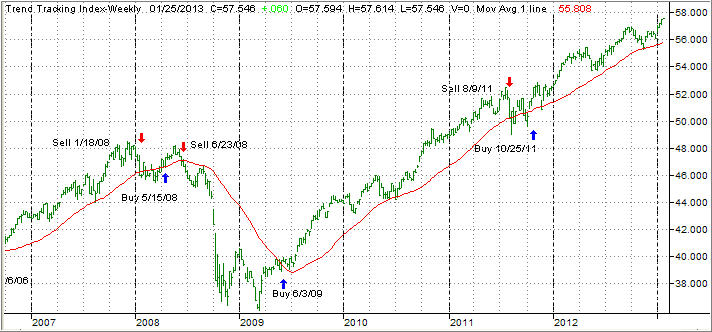
The domestic TTI broke through its long-term trend line generating a Sell for this area effective 8/9/2011. Over the recent past, we’ve seen the TTI hovering slightly below and above this dividing line between bullish and bearish territory. The clear break to the upside occurred on 10/24/11 and, effective 10/25/11, a new Buy signal for domestic equities went into effect.
As of today, our Trend Tracking Index (TTI—green line in above chart) has broken above its long term trend line (red) by +1.08%. A break back below it will generate a Sell signal to move out of all domestic equity positions. Be sure to tune into my blog for the latest updates.
US equities snapped a two-day losing streak to end modestly higher as investors weighed better economic data against average corporate earnings report.
Economic data offered the silver lining after two day’s of hammering. Demand for durable goods jumped 9.9 percent in September, a Commerce Department report revealed.
Also, first time jobless claims came in better than expected, falling by 23,000 to 369,000 in the week ended Oct 20, a Labor Department report showed.
A third report showed pending-home sales rose 0.3 percent in September after a sharp fall in the prior month.
Risk sentiment got a boost after China’s Ministry of Industry and Information Technology said factory output is expected to grow at a faster pace in the final quarter of 2012, while preliminary data from the UK showed the country’s GDP grew by 1 percent in the third quarter, the fastest in five years.