ETF/No Load Fund Tracker Newsletter For Friday, June 7, 2013

Ulli ETF Tracker Contact

ETF/No Load Fund Tracker StatSheet

————————————————————-

THE LINK TO OUR CURRENT ETF/MUTUAL FUND STATSHEET IS:

https://theetfbully.com/2013/06/weekly-statsheet-for-the-etfno-load-fund-tracker-newsletter-updated-through-06062013/

————————————————————

Market Commentary

Friday, June 7, 2013

BULLS CHEER UNEMPLOYMENT REPORT

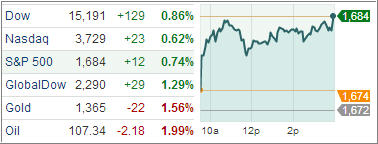
A wild week of trading came to an end with U.S. markets closing nicely higher as the Dow Jones Industrial Average scored its best day since January 2, and the Standard & Poor’s 500 Index ended a two-week losing streak with the best two-day rally since January.

The Dow closed 208 points higher (1.4%) at 15,248, the S&P 500 Index increased 21 points (1.3%) to 1,643, and the Nasdaq Composite ascended 45 points (1.3%) to 3,469. Stocks rallied after a mixed May employment report, which may suggest that the Federal Reserve will at least maintain its current pace of asset purchases until the lukewarm U.S. economy can show substantial signs of improvement.

Nonfarm payrolls increased by 175,000 in May, close to the consensus of 169,000. The unemployment rate, however, ticked up for the first time in four months on rounding to 7.6% from 7.5%, above expectations of 7.5%. The average workweek remained at an upwardly revised 34.5 hours. The labor force expanded by 420,000, with 319,000 more people counted as employed and 101,000 more unemployed. Those not in the labor force fell by 231,000, the biggest decline in seven months.

Read More

Weekly StatSheet For The ETF/No Load Fund Tracker Newsletter – Updated Through 06/06/2013

Ulli ETF StatSheet Contact

ETF/Mutual Fund Data updated through Thursday, June 6, 2013

Table of Content082312

If you are not familiar with some of the terminology used, please see the Glossary of Terms.


1. DOMESTIC EQUITY MUTUAL FUNDS/ETFs: BUY — since 10/25/2011

TTI

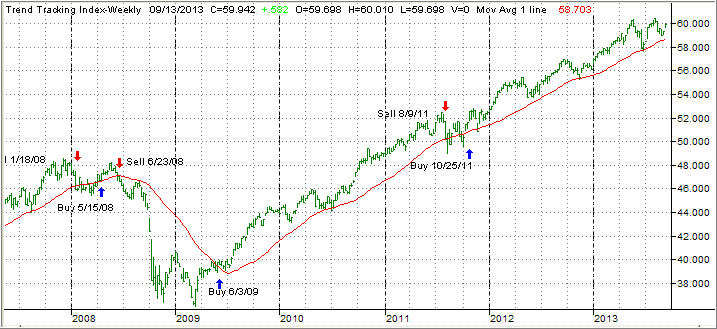
The domestic TTI broke through its long-term trend line generating a Sell for this area effective 8/9/2011. Over the recent past, we’ve seen the TTI hovering slightly below and above this dividing line between bullish and bearish territory. The clear break to the upside occurred on 10/24/11 and, effective 10/25/11, a new Buy signal for domestic equities went into effect.

As of today, our Trend Tracking Index (TTI—green line in above chart) has bounced off its long term trend line (red) by +2.82% as part of the post election rebound.

To avoid a potential whip-saw, a Sell signal to move out of all domestic equity positions will be generated once we have clearly pierced the line to the downside. Be sure to tune in for the latest updates.

Read More

Bulls Fight Off Bears To Shed The Red

Ulli Market Commentary Contact

Thur pic

[Chart courtesy of MarketWatch.com]

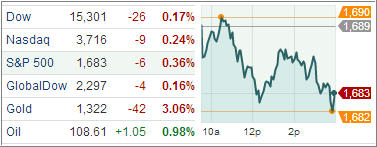
U.S. equities shed earlier losses and closed the trading session in positive territory, allowing stocks to snap their recent two-day losing streak and avoid giving the Dow its first three-session decline of the year.

The Dow Jones Industrial Average added 80 points (0.5%) to 15,041, the S&P 500 Index moved 14 points (0.8%) higher to 1,622, and the Nasdaq Composite increased 23 points (0.7%) to 3,424.

The Dow today slipped below its 50-day moving average of 14,923.91. That was the first time this year it happened for the 30-stock gauge. The S&P 500 also spent the first half of today’s session attempting to climb above yesterday’s afternoon highs. However, around midday, the index briefly slipped below its 50-day moving average of 1,604 – the first time the benchmark has dropped below that technical level since April 18.

By mid-afternoon, the S&P reversed course and ended the day up 0.9 percent. Cyclical sectors were whipsawed early in the session, but the afternoon advance helped five of the six growth-oriented groups register gains. The session’s best performers included financials and health care, with each ending up 1.4 percent. Homebuilders rallied broadly after displaying notable softness over the past few sessions.

Read More

Stocks Slump As More Fears Of Less Fed Stimulus Mount

Ulli Market Commentary Contact

Wed pic

[Chart courtesy of MarketWatch.com]

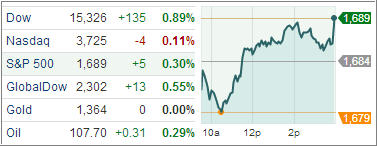
Investors have sent stocks on a wild ride in recent sessions amid fears the central bank will trim stimulus while the economy remains weak. Recent selling could suggest the market may be moving away from its seven-month rally.

The Standard & Poor’s 500 Index moved 23 points (1.4%) lower to 1,609. Today’s loss came on the heels of yesterday’s weakness and the continued decline caused the benchmark average to fall 3.6 percent since its all-time closing high on May 21, a day before Fed’s Bernanke said the U.S. central bank may decide to taper its stimulus. The Dow Jones Industrial Average fell 217points (1.4%) to 14,961 and the Nasdaq Composite declined 44 points (1.3%) to 3,401.

All ten sectors ended in the red as declining issues outpaced advancers by a 4.4 to 1 ratio. Cyclical groups were among the main casualties of today’s selloff as four of six growth-oriented sectors saw losses in excess of 1.6%. Although cyclical sectors faced the bulk of today’s selling, defensively-oriented groups were not far behind. Consumer staples, utilities, and telecom services each lost between 0.9% and 1.2% while the health care sector slumped 1.4%.

Read More

7 ETF Model Portfolios You Can Use – Updated through 6/4/2013

Ulli Model ETF Portfolios Contact

Heading south and off their lofty levels was the theme of the last week with the S&P 500 losing some 1.75% since last Tuesday’s ETF Model Portfolio report.

Continuous talk about the Fed’s possible tapering of the infinite QE program, also known as Wall Street’s punch bowl, has created nervousness in the market place as exuberance has waned causing the major indexes to reverse direction and come off their highs.

To be clear, given the reckless advances of the past few months, the pullback has been fairly minor so far, however, some areas have been hit harder than others. With interest rates inching higher, causing bond prices to slip, and equities on the skids, the usual equilibrium (lower stock prices, higher bond prices) has been upset for the time being.

If this continues, bonds may no longer be the offsetting factor to mitigate any equity slide. That’s why it’s important to have an exit strategy in case things accelerate to the downside. In portfolio #5, the Emerging Markets Bond fund (EMB) triggered its trailing sell stop on Monday, and was liquidated on Tuesday.

Five of our ETF Model Portfolios contain VNQ, which slipped past its sell stop point at yesterday’s close and will be eliminated today, unless a rally materializes, which would cause me to hold off another day.

Here’s the latest ETF Model Portfolio update:

Read More

06-05-2013

Ulli Newsletter Archives Contact

Buy-Sell Cycles

The ETF/No Load Fund Tracker

Monthly Review—May 31, 2013

US Equities Finish May With A Whimper; Europe Rises For The 12th Month

US equity indexes finished higher in May with the S&P 500 index clocking its longest winning streak since September 2009 despite a sharp pullback on the last trading day of the month. Wall Street closed another month of gains on a somber note as mixed economic reports took some of the sheen off of an otherwise robust May.

The blue-chip Dow Jones Industrial Average finished the month 1.9 percent higher. The S&P 500 added 2.1 percent while the tech-heavy NASDAQ Composite jumped 3.8 percent for the month.

Financials performed the best among all the business sectors in May, followed by industrials and technology. Healthcare slipped 2.2 percent, trimming its year-to-date gain to 20.1 percent. Although the markets didn’t witness the so-called ‘great rotation’ of funds out of bonds and into stocks, investors nevertheless, rotated money in and out of sectors in search of bargains.

Economic data for the month remained mixed. The Chicago Purchasing Managers’ Index jumped to its highest level since March 2012 with May’s reading coming at 58.7 following April’s disappointing print of 49. All the key subcomponents of the index, including order-backlogs, new orders, production and employment all notched up significant gains for the month.

Separately, the Thomson Reuters-University of Michigan consumer sentiment index ticked up to 84.5, the highest since July 2007. The housing market continued to improve as pending home sales rose 0.3 percent in April, a report by the National Association of Realtors showed.

Also, durable goods orders climbed 3.3 percent in April after declining 5.9 percent in March. Excluding transportation, durable goods demand rose 1.3 percent after declining 1.7 percent in March. Transportation orders surged 8.1 percent in April as defense and nondefense aircraft orders vaulted 25.7 percent in April.

On the flipside, a report by the Commerce Department showed the US economy grew less than expected last quarter. Gross domestic product expanded at an annual pace of 2.4 percent in the first three months, a touch lower from the initial estimate of 2.5 percent.

A separate report by the Commerce Department showed household purchases fell 0.2 percent in April following 0.1 percent in March. Incomes, however, remained unchanged.

Initial jobless claims rose more than expected in the final week of the May, spurring concerns of a slowdown in the labor market just when economists started to grow optimistic about the outlook.

Weak jobless and GDP numbers raised hopes the US Fed won’t taper its level of monthly bond purchases anytime soon. Also Ben Bernanke’s comment that premature tightening of monetary policy could stall the pace of recovery before the Joint Economic Committee on May 22 boosted investor sentiment.

Europe meanwhile continued to advance with the pan-European Stoxx Europe 600 index ticking higher for the 12th straight month.

Germany’s DAX 30 index rose 5.5 percent in May while France’s CAC 40 index added 2.4 percent for the month. UK’s FTSE 100 index picked up 2.4 percent for the month.

Unemployment, however, remained stubbornly high in the 17-member common currency zone with latest data showing jobless rate rising to 12.2 percent in April from 12.1 percent in the previous month.

Our main directional indicator, the Domestic Trend Tracking Index (TTI) remained solidly entrenched on the bullish side of the trend line (red) as the chart shows:

TTI

However, please note the reversal towards the end of the month (upper right) as the sell-off pulled this indicator off its lofty levels.

After a gangbuster April, things slowed down a bit during the second half of May, as our main holdings in the low volatility ETFs XLP and SPLV were not able to keep up their torrid pace from the previous months and gave back some of their gains. DVY held up better but still ended May in the red by -1.28%.

It sure was interesting to witness that these low volatility funds sold off faster than the major indexes. Usually, the opposite is the case, but since we are in unchartered territory, thanks to the Fed’s reckless monetary policies, nothing should come as a surprise.

To my way of thinking, low volatility weakness could signal that a major directional change is about to happen, kind of like being the proverbial canary in the coal mine, or, investors simply ditched conservative funds in favor of aggressive funds in anticipation of the bull market  pushing the indexes to the next higher level.

Be that as it may, we will follow my existing theme of holding on until our trailing sell stops kick in and point us to the exit door. Anything else would be just pure guesswork.

In this uncertain environment where bad news is good news and good news is good news, while worse news is even better news, as far as bullish tendencies are concerned, we need to be disciplined, so we have some means of control in what seems like an out of control market environment.