Weekly StatSheet For The ETF/No Load Fund Tracker Newsletter – Updated Through 10/03/2013

Ulli ETF StatSheet Contact

ETF/Mutual Fund Data updated through Thursday, October 3, 2013
Table of Content082312

If you are not familiar with some of the terminology used, please see the Glossary of Terms.


1. DOMESTIC EQUITY MUTUAL FUNDS/ETFs: BUY — since 10/25/2011
TTI

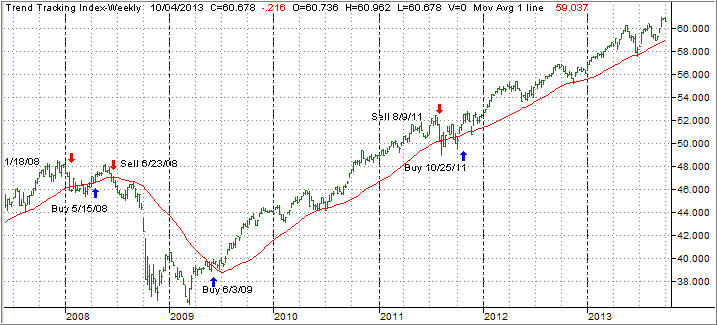
The Domestic TTI broke through its long-term trend line generating a Sell for this area effective 8/9/2011. Over the recent past, we’ve seen the TTI hovering slightly below and above this dividing line between bullish and bearish territory. The clear break to the upside occurred on 10/24/11 and, effective 10/25/11, a new Buy signal for domestic equities went into effect.

As of today, our Trend Tracking Index (TTI—green line in above chart) has bounced off its long term trend line (red) by +2.95% after briefly dipping below it late in June 2013.

To avoid a potential whip-saw, a Sell signal to move out of all domestic equity positions will be generated once we have clearly pierced the line to the downside. Be sure to tune in for the latest updates.
Read More

Floating Lower

Ulli Market Commentary Contact

Thur pic

[Chart courtesy of MarketWatch.com]

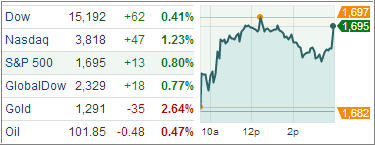
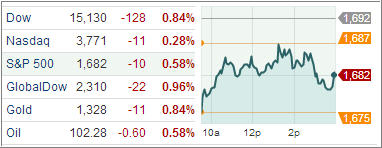
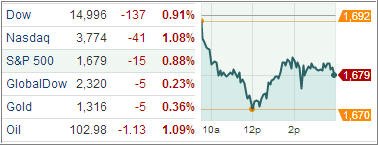
Domestic equities slipped for the second-straight session on Thursday, with the Standard & Poor’s 500 Index dropping the most in a month, as global and domestic investors continue to anxiously await resolutions from Congress to solve Washington’s budget crisis.

The situation has now partially shut down the government for three days, while the debt ceiling limit is swiftly approaching. So far market losses have been limited during shutdowns, but they did reach about 17 percent in the summer of 2011 just before the debt ceiling was raised. Should this end up in similar fashion, it pays to have your sell stops ready to be executed.

Equities retreated throughout the morning before finding support in the early afternoon following an article in The New York Times indicating Speaker of the House John Boehner told Republicans he would not allow a default to take place. Thanks to the rebound, the S&P was able to erase a third of its losses, but could not close above its 50-day moving average (1680). All ten sectors ended in the red with influential groups like consumer discretionary (-1.0%), industrials (-1.1%), and technology (-1.0%) leading to the downside.

Read More

Shut Down Pressures Stocks

Ulli Market Commentary Contact

Wed pic

[Chart courtesy of MarketWatch.com]

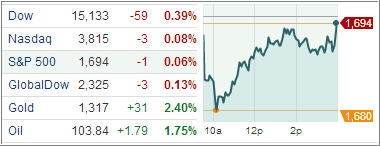
U.S. equities ended slightly in the red after spending most of the session in a steady climb off the opening low, as domestic markets erased chunks of yesterday’s gains during the second day of the partial government shutdown.

Adding to worries is the report of a disappointing private sector job growth, which could be the only piece of September payroll data we get this week amid the government shutdown. Treasuries were higher in the wake of the employment data, as well as a dip in weekly domestic mortgage applications.

The shutdown fight is rapidly merging with a higher-stakes battle over the government’s borrowing power that is expected to come to a head soon. Many analysts believe that the longer the shutdown goes on, and the more headlines shift towards the October 17 deadline, investors are becoming more and more concerned. A partial shutdown lasting one week would probably shave 0.1 percentage point from economic growth, according to the median estimate of economists, with the costs accelerating if the closing persists.

Read More

7 ETF Model Portfolios You Can Use – Updated through 10/1/2013

Ulli Model ETF Portfolios Contact

The markets were in slipping and sliding mode since I posted last week’s Model Portfolio report, but yesterday’s rebound rally brought the S&P 500 almost back to where we started 5 trading days ago; the loss was a meager 2 points.

Hopes for a short-lived government shutdown prevail, which helped power yesterday’s rally. Of course, the debt ceiling debacle lingers on the horizon along with general uncertainty about the affordable care act, which went into effect on Oct. 1st.

All models have been meandering over the past week with no notable changes. With the always unpredictable month of October upon us, it’s a wild guessing game as to how the markets will react to the ever growing menu of uncertainties.

Be sure to know where your sell stops should be and execute them when necessary.

In the meantime, here’s the latest ETF Model Portfolio update:

Read More

Stocks Ignore Shutdown; Buyers Step In

Ulli Market Commentary Contact

Tue pic

[Chart courtesy of MarketWatch.com]

After falling to a three-week low yesterday, U.S. equity markets closed the trading session higher to begin the new month and quarter, led by some upbeat manufacturing activity data despite the first partial government shutdown in 17 years.

Investors for now appeared confident that the situation would be short-lived. After dropping seven out of the past eight sessions on concerns about a possible shutdown, traders viewed the pullback as a buying opportunity in the absence of an extended shutdown.

Stocks made the bulk of their advance during the opening minutes before spending most of the afternoon near their highs. Equities appeared unconcerned with the first day of the government shutdown. All ten sectors posted gains as equities drew strength from typical start-of-quarter inflows. Risk assets also benefited from the rebound in Europe where yesterday’s fears of a possible collapse of the Italian government were alleviated.

Read More

Bears Awaiting Government Shut Down

Ulli Market Commentary Contact

Mon pic

[Chart courtesy of MarketWatch.com]

U.S. equities were broadly lower, as lawmakers on Capitol Hill continued to quarrel about spending issues with today’s midnight deadline to avoid a partial government shutdown, which is now quickly approaching.

Moreover, Italian political turmoil and a disappointing manufacturing activity read from China exacerbated sentiment. Meanwhile, Treasuries were higher following stronger-than-expected reads on domestic regional manufacturing activity and, as the fiscal showdown in Washington heats up, may be reflecting increased demand for safe haven assets.

Stocks stumbled out of the gate. All ten sectors settled in the red with consumer staples (-1.1%) leading to the downside. Meanwhile, other countercyclical groups ended mixed. Health care (-0.3%) and utilities (-0.1%) outperformed while telecom services (-0.6%) finished in-line. The S&P 500 struggled with its 50-day moving average (1,680) throughout the afternoon, but managed to close just above that level despite weakness among several cyclical sectors.

Read More