Weekly StatSheet For The ETF Tracker Newsletter – Updated Through 09/15/2016

Ulli ETF StatSheet Contact

ETF Data updated through Thursday, September 15, 2016
TOC082516

Methodology/Use of this StatSheet:

  1. From the universe of over 1,800 ETFs, I have selected only those with a trading volume of over $5 million per day (HV ETFs), so that liquidity and a small bid/ask spread are assured.
  2. Trend Tracking Indexes (TTIs)

Buy or Sell decisions for Domestic and International ETFs (section 1 and 2), are made based on the respective TTI and its position either above or below its long-term M/A (Moving Average). A crossing of the trend line from below accompanied by some staying power above constitutes a “Buy” signal. Conversely, a clear break below the line constitutes a “Sell” signal. Additionally, I use a 7.5% trailing stop loss on all positions in these categories to control downside risk.

  1. All other investment arenas do not have a TTI and should be traded based on the position of the individual ETF relative to its own respective trend line (%M/A). That’s why those signals are referred to as a “Selective Buy.” In other words, if an ETF crosses its own trendline to the upside, a “Buy” signal is generated. Since these areas tend to be more volatile, I recommend a wider trailing sell stop of 7.5% -10% depending on your risk tolerance.

If you are unfamiliar with some of the terminology, please see Glossary of Terms and new subscriber information in section 9.


1. DOMESTIC EQUITY ETFs: BUY — since 4/4/2016

tti

Our main directional indicator, the Domestic Trend Tracking Index (TTI-green line in the above chart) remains above its long-term trend line (red) by +2.29% after having generated a new Domestic Buy signal effective 4/4/2016 as posted.
Read More

Rebound Thursday; Apple Still Sweet

Ulli Market Commentary Contact

thur-pic

[Chart courtesy of MarketWatch.com]

1. Moving the Markets

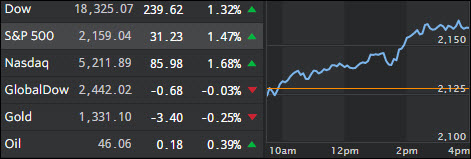
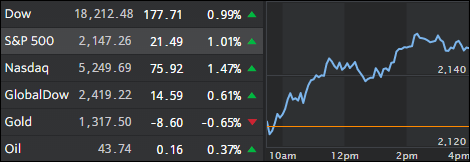
U.S. stocks, which have entered a difficult and more volatile stretch in recent sessions, were rebounding today despite lower-than-expected retail sales last month and continued concerns about whether central bank policy will become less market-friendly.

The Dow is being helped by another rally in shares of iPhone maker Apple (AAPL), which are up 3.4% today to $115.57, extending its gain this week to more than 12% on optimism surrounding the release of the latest version of the iPhone. This capped a 4-day surge which entails a 14% climb. While the iPhone 7 roll-out may not be as dazzling as predecessors, it seems that the brand still holds weight regardless.

With interest rate uncertainty weighing on markets ahead of the Federal Reserve’s highly anticipated policy decision next Wednesday, Wall Street turned its attention to a batch of fresh economic data today, which came in mixed. In a sign that consumers are spending less, August retail sales fell 0.3%, which was more than the drop 0.1% analysts had forecast. That was the first time monthly sales have been negative since March this year. On the inflation front, prices at the wholesale level also came in lower-than-expected, with the producer price index (PPI) coming in 0.1% shy of the September forecast.

Read More

Sloppy Wednesday; Bayer To Acquire Monsanto

Ulli Market Commentary Contact

wed-pic

[Chart courtesy of MarketWatch.com]

1. Moving the Markets

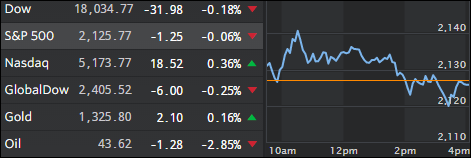
After early gains, U.S. stocks ended mixed following a steep drop Tuesday and a three-session bout of heightened volatility sparked by fears of rising interest rates.

Investors have been jittery of late. Worries include fears that higher interest rates will hurt the economy, overvalued stock prices and continued uncertainty over the presidential election, not to mention the strength of the economy. The biggest weight on the economy has been justifiable concern that the U.S. equities and other financial assets have been artificially inflated due to the easy-money policies of central bankers. That has raised fears of a long overdue correction to get prices better aligned with business fundamentals, such as corporate earnings and the slower growth rate of the U.S. economy.

There was big news in the Agriculture world today. Germany-based health and agricultural giant Bayer reached a deal to acquire St. Louis-based seed and pesticide firm Monsanto (MON) for $66 billion in yet another jolt to a global agricultural sector that has been rocked by sluggish crop prices. The good news for Monsanto is that Bayer agreed to pay a $2 billion breakup fee if the deal collapses under anti-trust pressure.

Oil prices, which fell 3% on Tuesday, and were a factor in the steep slide in stocks, have remained volatile today. However, by day’s end, a barrel of U.S.-produced crude was up 11 cents, or 0.2%, to $45.01 per barrel.

Read More

The Morning After A Dead Cat Bounce

Ulli Market Commentary Contact

tue-pic

[Chart courtesy of MarketWatch.com]

1. Moving the Markets

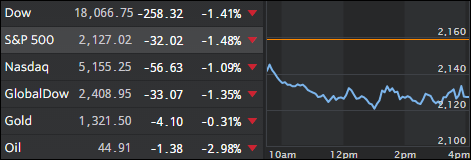
Today’s pullback certainly made yesterday’s rebound look like a dead cat bounce. Of course, you can never be sure but stocks shifted into reverse today falling sharply led by lower oil prices and weak financials.

Despite Fed officials taking a more dovish stance, there appears to be a heightened level of insecurity regarding potential rate hikes; or, markets have gotten simply tired of the endless jawboning and have lost confidence in the Fed’s commentary du jour.

Again, volatility has returned, and the major indexes have moved more than 1% in either direction in the past 3 days, which is something that we’ve not seen all summer. There is probably more to come, and it is important that you know when to execute your sell stops just in case this pullback turns into a full blown bear market.

If you tend to ignore bear markets, please take a look at the chart below:

Read More

Rebounding Off The Friday Lows

Ulli Market Commentary Contact

mon-pic

[Chart courtesy of MarketWatch.com]

1. Moving the Markets

On Friday, I mentioned that the Fed might attempt to talk this market back up after the sharp and sudden pullback. As if on cue, three Fed govs, namely Brainard, Lockhart and Kashkari, used various venues to opine the predominantly dovish message that a rate hike might not be compelling.

That’s all it took, and the algos ran amok pulling the major indexes out of the doldrums and, more importantly, pulled interest rates back down after Friday’s spooky spike. Of course, no one can be sure that all is well again, and that we’ll continue to go higher from here. Personally, I expect more fireworks as we head deeper into the notoriously volatile season of the year.

In oil news today, we saw U.S. Crude imports rise .31% to $46.02 a barrel. U.S. average never really rose above $50 a barrel over the summer months, which usually experience high seasonality increases due to travel. That is leading analysts to believe that prices will remain within the $40-$50 a barrel bracket through the fall season.

Read More

One Man’s Opinion: Investors Are Sticking With Pavlov’s Dog Until Everything Breaks

Ulli Market Review Contact

OneMan'sOpinionBy Zero Hedge

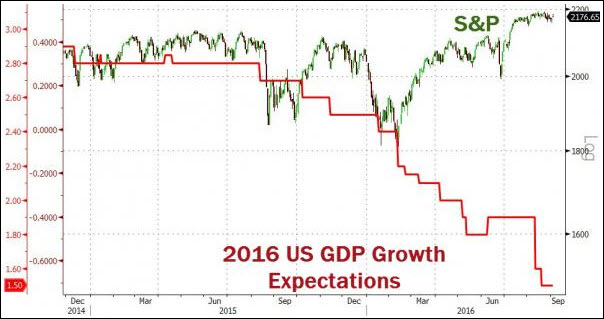
Remember when “bad news is good news” first leapt into common parlance? At first it was used as a way to describe the reaction function of Fed policy-makers. It was taken as a cute turn of phrase in encapsulating the state of the world. Over time, as Bloomberg’s Richard Breslow explains, it’s morphed into an ugly and cynical way of justifying mindless investing behavior.

chart1

Central banks that cultivated and encouraged irrational exuberance as their main transmission mechanism of monetary policy are now hopelessly caught in its infinite loop. Seemingly feeling the need to continue doing more of the same, no matter the efficacy.

Read More