Weekly StatSheet For The ETF Tracker Newsletter – Updated Through 04/06/2017

Ulli ETF StatSheet Contact

ETF Data updated through Thursday, April 6, 2017
Methodology/Use of this StatSheet:

  1. From the universe of over 1,800 ETFs, I have selected only those with a trading volume of over $5 million per day (HV ETFs), so that liquidity and a small bid/ask spread are assured.
  2. Trend Tracking Indexes (TTIs)

Buy or Sell decisions for Domestic and International ETFs (section 1 and 2), are made based on the respective TTI and its position either above or below its long-term M/A (Moving Average). A crossing of the trend line from below accompanied by some staying power above constitutes a “Buy” signal. Conversely, a clear break below the line constitutes a “Sell” signal. Additionally, I use a 7.5% trailing stop loss on all positions in these categories to control downside risk.

  1. All other investment arenas do not have a TTI and should be traded based on the position of the individual ETF relative to its own respective trend line (%M/A). That’s why those signals are referred to as a “Selective Buy.” In other words, if an ETF crosses its own trendline to the upside, a “Buy” signal is generated. Since these areas tend to be more volatile, I recommend a wider trailing sell stop of 7.5% -10% depending on your risk tolerance.

If you are unfamiliar with some of the terminology, please see Glossary of Terms and new subscriber information in section 9.


  1. DOMESTIC EQUITY ETFs: BUY — since 4/4/2016
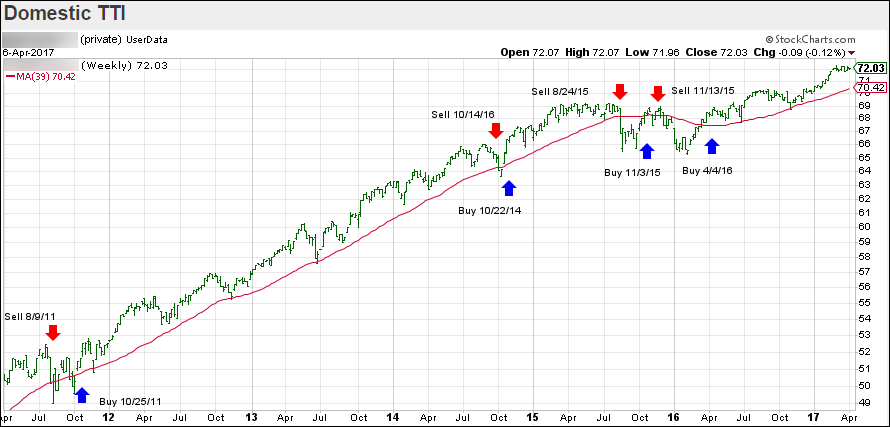
Click on chart to enlarge

Our main directional indicator, the Domestic Trend Tracking Index (TTI-green line in the above chart) is positioned above its long-term trend line (red) by +2.37% after having generated a new Domestic Buy signal effective 4/4/2016 as posted.

Read More

Waiting For Uncertainty To Pass

Ulli Market Commentary Contact

[Chart courtesy of MarketWatch.com]
  1. Moving the Markets

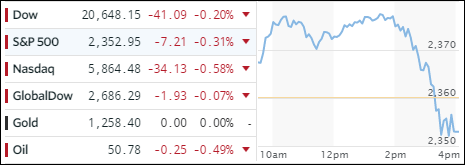
An early rally attempt lost steam again late in the session with today’s spoiler being Secretary of State Tillerson, who took center stage and reversed his view from last week that the US had no interest in removing the Syrian president to now beating the war drums and announcing “that steps are underway to remove Assad,” and that the US is “considering an appropriate response to the Syrian government’s alleged use of chemical weapons.” Keep in mind, the emphasis is on “alleged.”

That took the starch out of any upward momentum, however, the major indexes managed to eke out a tiny gain. The 10-year Treasury yield went sideways and closed down 2 points or -0.85% hovering at a crucial support level, while Financials (XLF) gained +0.64% but remain stuck below their 50-day M/A.

The US dollar managed to squeeze out a gain for the 3rd day in a row as uncertainty remained high in regards to the outcome of Trump’s meeting with the Chinese president, which could have a dramatic effect on the dollar. Additional, we are waiting for Friday’s March employment report. Expectations are high due to the recent strong numbers released by ADP.

Read More

Fed Spooks Wall Street And Reverses Morning Rally

Ulli Market Commentary Contact

[Chart courtesy of MarketWatch.com]
  1. Moving the Markets

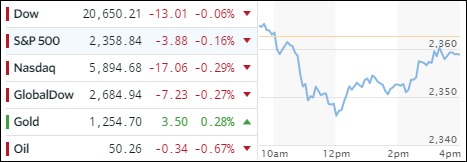
As the chart above shows, a morning rally got derailed in a hurry with the major indexes ending the session to the downside. A positive ADP report got things started in a northerly direction with the S&P 500 knocking on the 2,400 level. Data showed that 263,000 workers were added in March, which was higher than the expected number of 187,000 and also the largest addition since December 2014.

That was the green light for stocks to head higher, and the Dow jumped nearly 200 points. Suddenly, the Fed turned on the cold shower via its latest minutes delivering warning sound bites like you’d think you never hear from them explaining that “it was focusing not so much on inflation or employment, but was seeking to deflate what even “some members” of the FOMC agree is a stock bubble, warning that stock prices are “quite high”, and warning that its forecasts face “downside risks” if “financial markets were to experience a significant correction.

Further adding:

“A few participants attributed the recent equity price appreciation to expectations for corporate tax cuts or to increased risk tolerance among investors rather than to expectations of stronger economic growth. Some participants viewed equity prices as quite high relative to standard valuation measures.”

And then this:

… a number of participants remarked that recent and prospective changes in financial conditions posed upside risks to their economic projections, to the extent that financial developments provided greater stimulus to spending than currently anticipated, as well as downside risks to their economic projections if, for example, financial markets were to experience a significant correction.

It took a while for traders and computer algos to digest these clearly defined warnings before things went south. The good thing was that the markets were “saved” by the closing bell. It is not often that we see Fed speak of such clarity, and we’ll have to wait and see if there is more fallout to come or if this initial reaction was an outlier.

Read More

Another Successful Dump And Pump

Ulli Market Commentary Contact

[Chart courtesy of MarketWatch.com]
  1. Moving the Markets

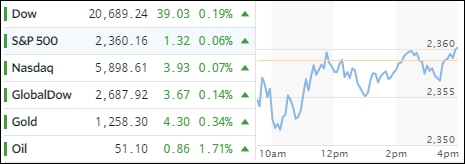
In a repeat from yesterday, the early market dump gave way to the usual pump to ensure that the major indexes closed in the green as it appeared that the BTD (Buy the Dip) crowd was out in full force. The Dow managed to kiss its 50-day M/A for the second day in a row and successfully used it as a springboard to eke out a small gain for the day.

Across asset classes, the retail sector (XRT) got clobbered again and lost -0.91%; the 10-year Treasury yield inched higher by +0.43% and oil gained +1.71% on news that inventories are allegedly seen declining. The dollar index was mainly flat throughout the session but closed slightly higher and remains above its psychologically important 100 level.

Precious metals gained again with gold now honing in on the 1,260 mark. Overall, things were slow on Wall Street with all eyes being on the upcoming China meeting, Friday’s payroll report followed by the start of the earnings season next Monday.

Read More

Grinding Back To The Unchanged Line

Ulli Market Commentary Contact

[Chart courtesy of MarketWatch.com]
  1. Moving the Markets

Two things pulled the rug out from early positive momentum at the opening. One, disappointing March auto sales, which should not have come as a surprise given the gigantic slip in retail sales including some 3,500 announced store closings, and two, the topic I have been pounding on lately, namely that questions about Trump’s pro-business stimulus plans continue to make headlines as to whether they really can be implemented in a timely manner. But, hope still prevails…

As we’ve seen many times before, the downside slip was contained, and the indexes spent the rest of the session grinding back towards the unchanged line but did not manage to cross it to the upside. Weakness in the markets was broad with the exception of Emerging Markets, which managed to gain +0.88%, while gold also closed up.

The dollar was modestly higher, but interest rates continued their recent downward slide with the 20-year T-bond (TLT) gaining +1.01%.

Adding to the general nervousness was news about a probable terrorist attack in Russia, which killed 10 people.

Read More

One Man’s Opinion: The US Government Now Has Less Cash Than Google

Ulli Market Review Contact

Authored by Simon Black via SovereignMan.com,

In the year 1517, one of the most important innovations in financial history was invented in Amsterdam: the government bond.

It was a pretty revolutionary concept.

Governments had been borrowing money for thousands of years… quite often at the point of a sword.

But the Dutch figured out how to turn government loans into an “investment”.

It caught on slowly. But eventually government bonds became an extremely popular asset class.

Secondary markets developed where people who owned bonds could sell them to other investors.

Even simple coffee shops turned into financial exchanges where investors and traders would buy and sell bonds.

In time, the government realized that its creditworthiness was paramount, and the Dutch developed a reputation as being a rock-solid bet.

This practice caught on across the world. International markets developed.

Read More