Weekly StatSheet For The ETF Tracker Newsletter – Updated Through 08/31/2017

Ulli ETF StatSheet Contact

ETF Data updated through Thursday, August 31, 2017

Methodology/Use of this StatSheet:

  1. From the universe of over 1,800 ETFs, I have selected only those with a trading volume of over $5 million per day (HV ETFs), so that liquidity and a small bid/ask spread are assured.
  2. Trend Tracking Indexes (TTIs)

Buy or Sell decisions for Domestic and International ETFs (section 1 and 2), are made based on the respective TTI and its position either above or below its long-term M/A (Moving Average). A crossing of the trend line from below accompanied by some staying power above constitutes a “Buy” signal. Conversely, a clear break below the line constitutes a “Sell” signal. Additionally, I use a 7.5% trailing stop loss on all positions in these categories to control downside risk.

  1. All other investment arenas do not have a TTI and should be traded based on the position of the individual ETF relative to its own respective trend line (%M/A). That’s why those signals are referred to as a “Selective Buy.” In other words, if an ETF crosses its own trendline to the upside, a “Buy” signal is generated. Since these areas tend to be more volatile, I recommend a wider trailing sell stop of 7.5% -10% depending on your risk tolerance.

If you are unfamiliar with some of the terminology, please see Glossary of Terms and new subscriber information in section 9.


  1. DOMESTIC EQUITY ETFs: BUY — since 4/4/2016
Click on chart to enlarge

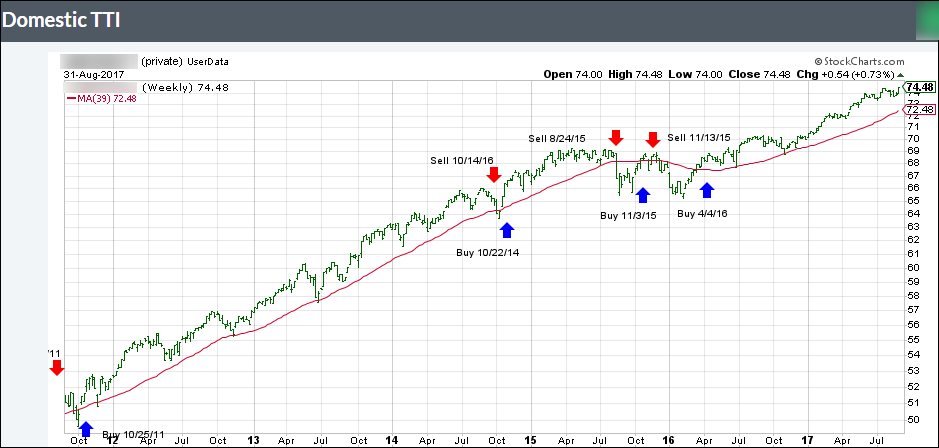
Our main directional indicator, the Domestic Trend Tracking Index (TTI-green line in the above chart) is positioned above its long-term trend line (red) by +2.95% after having generated a new Domestic Buy signal effective 4/4/2016 as posted.
Read More

Mission Accomplished: S&P Closes In The ‘Green’ For August

Ulli Market Commentary Contact

[Chart courtesy of MarketWatch.com]
  1. Moving the Markets

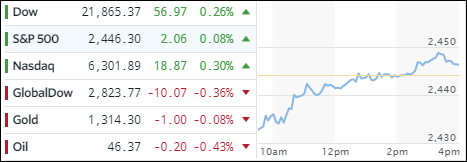
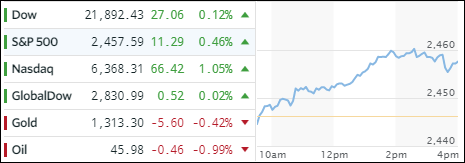
The past few days, I have commented on the fact that the S&P was in danger of notching its first losing month in 2017, and that there was a good chance efforts would be made to push the index in the ‘green.’ That’s exactly what happened and, even though we managed to add only 2 points or +0.08% for August, it will register as a gain in the record books. This is in line with the modest advances we saw in the Dow and Nasdaq.

A couple of econ reports supported the bullish theme with low levels of first-time jobless claims being interpreted as a positive while consumer spending allegedly picked up in July; of course, don’t be surprised if/when these numbers get revised next month.

In regards to our main holdings, we saw International SmallCaps (SCHC) take the lead today with +1.07%. Performing almost just as well were US SmallCaps (SCHA) with a gain of +0.98% and MidCaps (SCHM) adding +0.93%. Lagging the top performers but still closing higher were Transportations (IYT) with +0.13%.

Gold popped nicely after last night’s flash crash, which pulled the metal down below its $1,300 marker, but dip buyers stepped in and were the main contributor to the +1.03% gain. Interest rates dropped again, and the 20-year bond (TLT) continued its march higher by adding +0.30%. The entire month was market by tumbling yields, which was their biggest drop since the middle of 2016. The US dollar (UUP) traded in a wide range but closed lower by -0.29%.

Read More

When Only Good News Matters

Ulli Market Commentary Contact

[Chart courtesy of MarketWatch.com]
  1. Moving the Markets

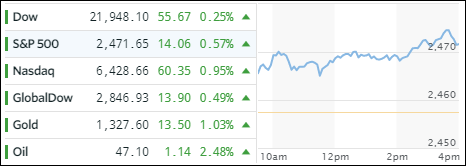
Even though I was a little facetious yesterday when commenting that the S&P needs to rally for the remaining 3 sessions of August to maintain its spotless record of rising every month, today was a step in the right direction. The Dow and Nasdaq managed to climb into the “green,” and the S&P needs to only make up 0.5% by tomorrow to accomplish the feat of 8 consecutive months of gains.

Helping the bullish cause, in the face of continuing geopolitical tensions between the U.S. and N. Korea and more fallout from Harvey, were a couple of strong economic reports namely an alleged improved economic expansion in the second quarter along with ADP indicating that private-sector employers added 237k jobs in August, which was far above the expected 185k. Only good news was accepted and mattered today, despite the fact that valuations are lofty and not necessarily representative of the real economy.

Be that as it may, equities were in rally mode and, with the Nasdaq being the lead dog, it comes as no surprise that Semiconductors (SMH) took 1st place with a solid +1.40%. SmallCaps (SCHA) had a nice day for a change, after recent weakness, and rebounded +0.71%. MidCaps (SCHM) ended up in 3rd place by adding +0.58%, closely followed by LargeCaps (SCHX) with +0.53%.

Yields on the 10-year bond rose 2 basis points pulling the 20-year bond off its high for the year by a tiny -0.03%. Gold dropped a fraction of a percent but remains above the widely followed $1,300 level. The whipping boy of the year, AKA the US Dollar (UUP), gapped higher and gained +0.63%.

Read More

Clawing Back From An Early Sell-Off

Ulli Market Commentary Contact

[Chart courtesy of MarketWatch.com]
  1. Moving the Markets

The early morning sell-off, which had the Dow down nearly 135 points, is now in the rearview mirror with the index staging its best intra-day comeback in 9 months. All the worries of the day, like continued provocations from N. Korea, debt ceiling talk and more fallout from hurricane Harvey, were either ignored or brushed aside to insure a “green” closing. After all, there are only 3 trading days left, and the S&P 500 still needs to gain +0.97% to make sure it does not experience its first losing month of 2017.

Across equity ETFs, the leader was, to no surprise as saber rattling was in full force, Aerospace & Defense (ITA) with a gain of +1.44%. Following closely were Transportations (IYT) with +0.91%, while Semiconductors (SMH) were lagging behind but still registering +0.28%. The minus side was led by International SmallCaps (SCHC) with -0.35% and International Equities (SCHF) losing -0.31% both a result of European markets getting clobbered.

Gold zigzagged and ended slightly lower but managed to successfully defend its $1,300 level. The yield on the 10-year bond dropped 3 basis points to 2.13% and is now hovering at a major support level. Any break below it and we could see much lower rates, which are quite a turnaround from the YTD highs of 2.52%, reached in early March. As a result of today’s lower yields, the 20-year bond (TLT) rallied +0.32%.

The US Dollar (UUP) had an interesting day. After getting hammered early on, it managed to recoup all of its losses and eked out a gain of +0.13%. Nevertheless, its long-term trend continues to be bearish, and I see more weakness ahead.

Read More

In Harvey’s Wake: Major Indexes Steady

Ulli Market Commentary Contact

[Chart courtesy of MarketWatch.com]
  1. Moving the Markets

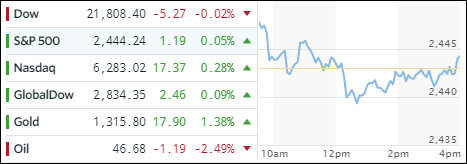
While Hurricane Harvey unleashed his enormous power over the weekend, the major indexes escaped pretty much unscathed and spent the session bouncing around their respective unchanged lines. The Nasdaq fared the best by gaining +0.28%. Retailers, along with the energy and financial sectors, slid early on but were not able to stage a bounce back later in the session.

Across our most widely tracked ETFs, Transportations (IYT) took 1st place with +0.35%, which was closely followed by Semiconductors (SMH) with a gain of +0.29%. On the losing side, MidCaps (SCHM) gave back -0.21%, while Dividend ETFs (SCHD) surrendered a tiny -0.11%.

Interest rates dropped a tad, but it wasn’t enough to push the 20-year bond (TLT) higher, instead, it lost -0.06%. To no surprise, with uncertainty caused by hurricane Harvey, gold was the beneficiary by gaining +1.38% to finally conquer its $1,300 milestone marker reaching a level last seen in October 2016. The US dollar (UUP) continued its bearish path for the year by making new lows and reaching a price point that we have not encountered since November 2014.

Read More

One Man’s Opinion: Here’s How The Next Recession Begins

Ulli Market Review Contact

By Simon Black

In 1886 there were only 38 states in the United States.

Electric power was still cutting edge technology that few people had ever seen.

The Statue of Liberty hadn’t even been dedicated yet.

But it was that year that a man named Richard Sears founded a small retail company in Minneapolis, Minnesota that would grow into a retail juggernaut.

Sears was truly the Amazon of its day.

Even in the late 1800s the company was able to deliver just about any product you wanted right to your doorstep.

This was no small feat considering the first delivery truck wouldn’t be invented until 1895. There was no transportation infrastructure. And two-thirds of the population lived in remote rural areas.

Yet despite those challenges, Sears was still able to put any product you wanted in your hands.

Over time as consumer trends changed, the company started opening physical retail stores.

And once the concept of the ‘shopping mall’ became popular, Sears department stores became a mainstay at malls across America.

Read More