Early Decline; Mid-Day Rally; Slumping Into The Close

Ulli Market Commentary Contact

[Chart courtesy of MarketWatch.com]
  1. Moving the Markets

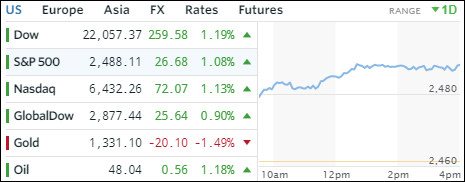
It was another session that ended in a mixed close with the major indexes giving up their hard fought mid-day gains, as they slumped into the close with only the S&P 500 showing a tiny gain of +0.04%. SmallCaps did better as both, domestic and international ones, managed to eke out +0.38% and +0.27% respectively.

Healthcare (XLV) saved the day and continued its winning ways of the past 4 days by adding another +1.04%, which was largely offset in the indexes by the Financials/Banks with the Regional Banking ETF (KRE) surrendering -0.67% while GS gave back -1.22%.

Interest rates slipped after one of the Fed’s mouthpieces (Bullard) uttered in an interview that “the Fed’s projected rate path may be too aggressive.” That helped the S&P to climb out of the red early on, but it was not enough to keep the momentum going. But, the 10-year bond yield slipped to settle at 2.15%.

Crude oil finally managed a rebound joined by the retailers with XRT closing up +0.59%, which looked more like a dead cat bounce than the beginning of a meaningful reversal. The US dollar meandered aimlessly with UUP closing up a tiny +0.04%.

Read More

Struggling For Direction

Ulli Market Commentary Contact

[Chart courtesy of MarketWatch.com]
  1. Moving the Markets

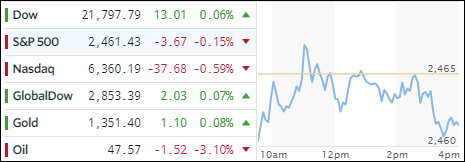
Crude oil along with the energy sector continued its slippery slide with XLE giving back -1.61%, while Crude Oil (WTI) crashed -2.53% to a $42 handle, which is its lowest since last August. Biotechs were the beneficiary of this carnage gaining some 8% over the past 3 days.

It’s a strange market, as even the big banks released the following quotes (Hat tip to ZH):

  1. BofA: “markets are very weird”
  2. JPM: “low vols will suffer catastrophic losses”
  3. DB: “cataclysmic events are coming”
  4. GS: “it will end in tears”
  5. Citi:”expect markets to flounder as central banks try to exit”

I mentioned yesterday that crude oil’s slippery path can be a harbinger of things to come and surely the energy arena has been the first victim. High yield credit (HYG) is starting to weaken as well because of its ties to energy financing. Retail followed the path of least resistance “down” and XRT lost -1.32%.

Bucking the trend was the Nasdaq, which surprisingly went straight up, never looked back and turned out to be the winner for the day. Treasury bonds were mixed with the 10-year yield remaining unchanged at 2.22%. The US dollar slipped -0.20% helping gold to close up and approaching its 200-day M/A from the downside.

Read More

Crude Oil Drops Into Bear Market Territory; Pulls Down Equities

Ulli Market Commentary Contact

[Chart courtesy of MarketWatch.com]
  1. Moving the Markets

Equities were not able to overcome the spanking that took place in oil patch and energy sector with oil touching the $42 handle and tumbling to the lowest level since last November. The transportation sector was affected as well with IYT sinking -1.73% and Natural Resources IGE dropping -1.41%. The Financials (IYF) headed south as well but to a lesser degree.

The Volatility Index (VIX) managed to climb above 11 and settled at 10.86 for a gain of +4.73%. As a result, the major indexes could not muster the usual last hour ramp as something was noticeably absent, and that was the dip buyers.

I talked about the flattening yield curve yesterday, which can function as a leading indicator to tell possible improvements in economic activity or forecast a potential recession. The 5/10 year bond yields are now at its flattest since 2007, which is the same flatness we saw when the last two recessions started, according to ZH.

Back to crude oil, the direction of which can also serve as a harbinger of things to come. With today’s drop, oil has now officially entered bear market territory, which is defined as a 20% plus drop from recent highs. I’ve charted this development below:

Read More

Valuation Worries Persist But S&P And Dow Hit Record Highs

Ulli Market Commentary Contact

[Chart courtesy of MarketWatch.com]
  1. Moving the Markets

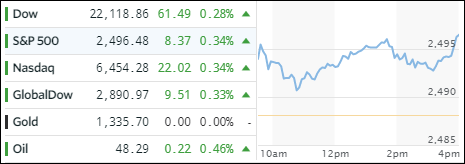
There was no hesitation nor looking back as the major indexes headed north right after the opening bell. The Dow and S&P scored new record highs while the Nasdaq rebounded solidly after last week’s weakness. The tech sector, as represented by XLK, added 1.5%, which was its biggest one-day gain since last December.

Of course, some see valuations as being way out of whack with the Fed’s tightening move, while at the same time, just about all data points are showing a weakening economic picture. Adding to the confusion was Fed’s Dudley uttering some hawkish tones that an “inverted yield curve” is not a problem. In case, you are not familiar with that term, ZH defines it this way:

An inverted yield curve, which has correctly predicted the last seven recessions going back to the late 1960’s, occurs when short-term interest rates yield more than longer-term rates. Why is an inverted yield curve so crucial in determining the direction of markets and the economy? Because when bank assets (longer-duration loans) generate less income than bank liabilities (short-term deposits), the incentive to make new loans dries up along with the money supply. And when asset bubbles are starved of that monetary fuel they burst. The severity of the recession depends on the intensity of the asset bubbles in existence prior to the inversion.

As a result interest rates rose (bonds down) with the 10-year T-Bond yield increasing 3 basis points to 2.19% and hovering just below its 200-day M/A of 2.21%. The dollar rallied with UUP gaining +0.44% while gold lost and settled at $1,246.20. Oil followed suit and is now stuck below the $45/barrel level, which is a 14.6% drop from its late May high of $52.00.

Read More

One Man’s Opinion: Banks are becoming less safe. Again.

Ulli Market Review Contact

By Simon Black

What I’m about to tell you isn’t some wild conspiracy. Or fake news.

It’s raw fact, based on publicly available data from the US Federal Reserve.

This data shows a very simple but concerning trend: banks in the United States are becoming less safe. Again.

And they’re doing it on purpose. Again.

Few people ever give much thought to the safety and security of their bank.

After all, banks go out of their way to instill an overwhelming sense of confidence that they’re rock solid.

They spend tons of money on ornate lobbies in giant buildings. They buy the naming rights to football and baseball stadiums.

And hey, they’re insured by the government.

But it turns out that none of these elaborate distractions means anything when it comes to bank safety.

Safety is actually pretty easy to calculate.

Read More

ETFs On The Cutline – Updated Through 06/09/2017

Ulli ETFs on the Cutline Contact

Below please find the latest High Volume ETFs Cutline report, which shows how far above or below their respective long-term trend lines (39 week SMA) my currently tracked ETFs are positioned.

This report covers the HV ETF Master List from Thursday’s StatSheet and includes 366 High Volume ETFs ETFs, defined as those with an average daily volume of more than $5 million, of which currently 277 (last week 282) are hovering in bullish territory. The yellow line separates those ETFs that are positioned above their trend line (%M/A) from those that have dropped below it.

Take a look:

The HV ETF Master Cutline Report            

In case you are not familiar with some of the terminology used in the reports, please read the Glossary of Terms.

If you missed the original post about the Cutline approach, you can read it here.