The ‘Everything’ Plunge

Ulli Market Commentary Contact

[Chart courtesy of MarketWatch.com]
  1. Moving the markets

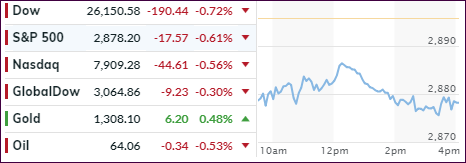
Apple Computers started today’s market fallout yesterday afternoon by announcing weaker than expected iPhone sales and shockingly reduced its revenue guidance. Part of the blame was put on China due to the “magnitude of their economic deceleration.” The punishment was instantaneous with Apple’s stock dropping some 8% in the after-hours session.

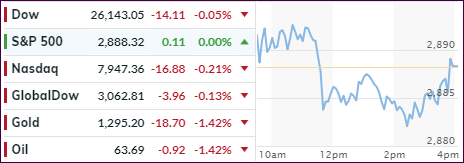
With that backdrop, it did not take a genius to figure out that today would be disastrous for equities, and that’s exactly what happened. Right after the opening bell, the Dow plunged some 650 points, before a modest climb reduced traders’ anxiety somewhat but, at the end of the session, we set new lows for the day.

In addition to bearish Apple news, manufacturing numbers (ISM) were terrible and showed a decline to 54.1 in December from 59.3 vs. an expected 57.9. This was the biggest monthly drop since the financial crises, when in October 2008 it slipped by 9 points.

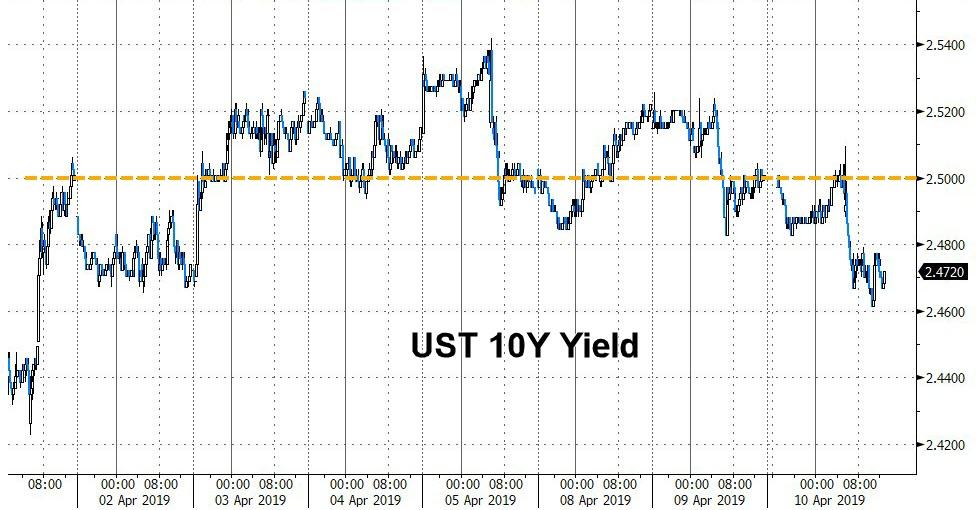
Everything plunged including bond yields with the 10-year sinking to 2.57%, its lowest level in a year. And as ZH noted, the 1-year bond yield is now only 2 basis points away from surpassing the yield on the 10-year making US recession fears even more realistic.

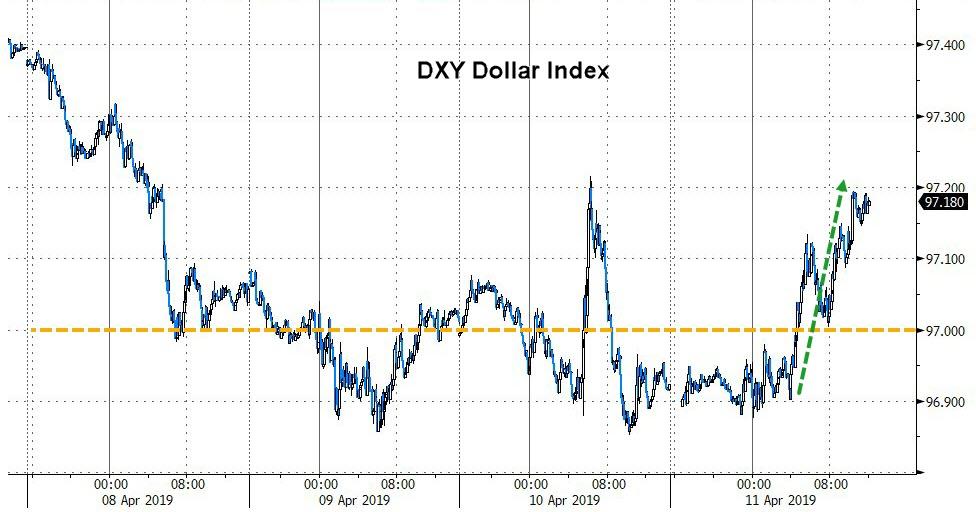
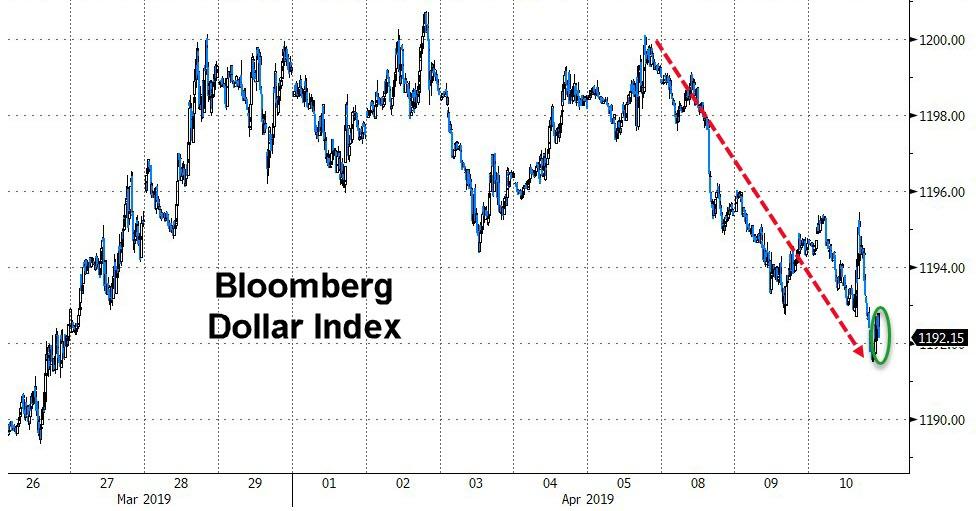
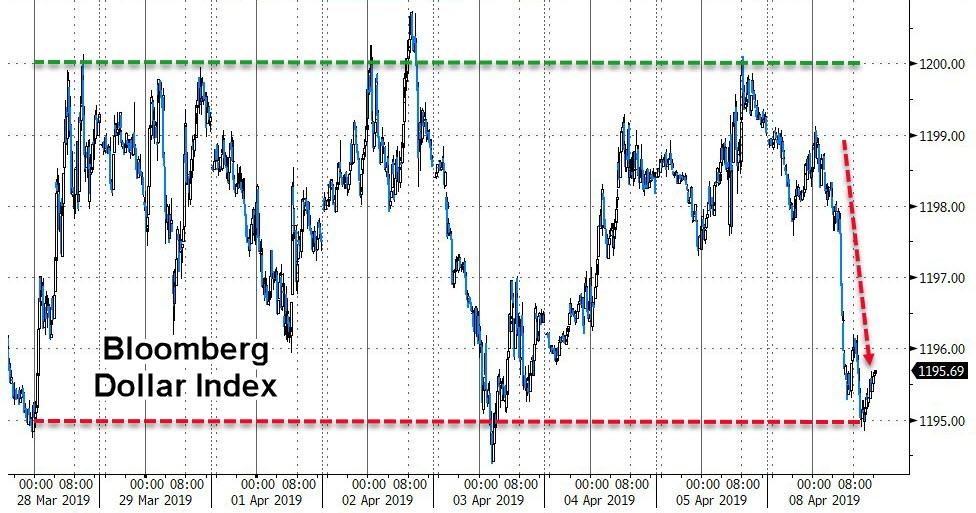
The US dollar fell as well, while only gold and oil showed some green numbers. The bear market is alive and well and has spread the suffering to well-known hedge fund managers, Warren Buffet’s Berkshire fund and the Swiss National Bank, which are all massive holders of Apple stock. Billions of dollars have been lost, as Apple has dropped some 31% in the past 3 months. Ouch!

It’s good to be on the sidelines, because the way things look there may be much more pain to come.

Read More

A Turbulent Session To Start 2019

Ulli Market Commentary Contact

[Chart courtesy of MarketWatch.com]
  1. Moving the markets

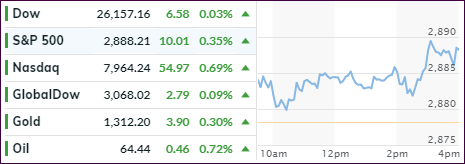
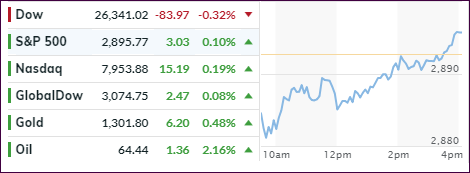
The opening dump to start the 1st trading day of 2019, with the Dow dropping almost 400 points, had investors on edge, until a slow climb pulled the major indexes out of the doldrums. Things looked shaky as market direction was predominantly sideways but, in the end, we closed in the green by a small margin.

Hurting the markets early on were worries about global growth, or rather lack thereof, especially in China, where manufacturing data showed a severe drop by tumbling to the weakest level since February 2016. Bullish support for equities arrived from the energy sector, as oil suddenly spiked over 2% (did an algo go wild?), but with that commodity being extremely volatile anyway, one should not read too much into that.

We saw dismal PMI data not only here in the US but also in Europe and China, which was negative for market sentiment, so a huge short squeeze was the second element that helped make this first trading day of the New Year one that ended up on the plus side of the unchanged line.

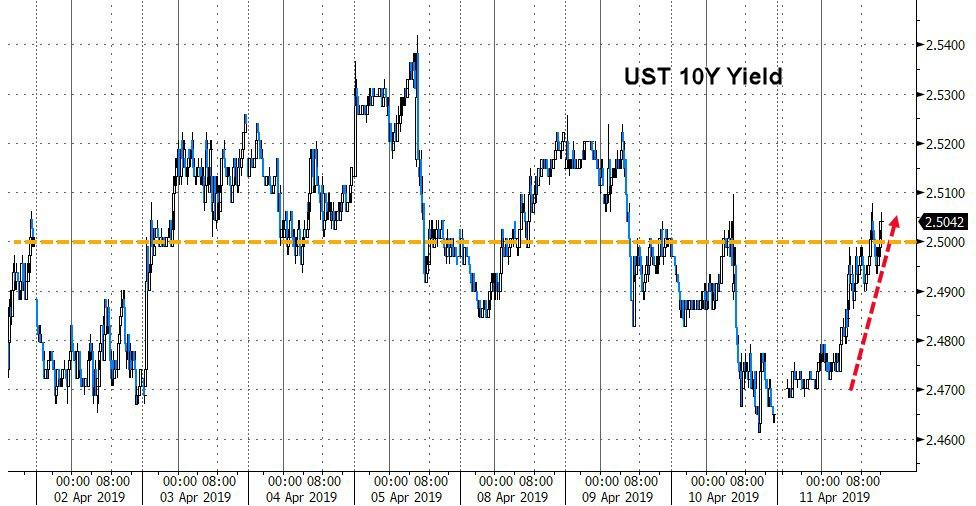
We saw chaos in the bond market with yields tumbling to 11-month lows, as the 10-year hit 2.60%, its lowest since last January as, despite a rate-hiking Fed, the global growth scare is weighing heavy on investors’ minds and crushing yields in the process.

The widely followed yield curve is now inverted from year 1 through year 8, meaning that short-term yields are higher than longer term ones, a condition that has always preceded a recession. Remember, bond investors are considered the smart money, which makes you wonder if equities must come down, as shown in this chart, to sync up with bond yields.

Read More

A Positive Ending To A Miserable Month/Year

Ulli Market Commentary Contact

[Chart courtesy of MarketWatch.com]
  1. Moving the markets

Despite last week’s rebound and today’s green close, it simply wasn’t enough to wipe out the losses of a miserable year and an even worse December. While for 2018 the S&P 500 “only” fell -6.2%, its biggest yearly tumble in a decade, this month left a bitter aftertaste with the index dropping -9.2%, as bearish forces remained dominant.

Individual stocks fared far worse with Dow component Goldman Sachs, for example, being down some 35% YTD, however, all systemically important banks collapsed, despite reassurances of “fortress” like balance sheets. Bear markets simply don’t discriminate, which means that in 2018 no corner of the world escaped unscathed.

On Wednesday, Wall Street will be again fully staffed with traders eager to make buy/sell decisions. Sure, optimistic trade news with China could give the current rally more support, but for how long?

To me, the unanswered question, that will have the biggest market impact, is this one: If the Fed reverses its widely “blamed” policy error (hiking rates), will this result in further market declines due to total loss of confidence or form the basis for a new bull market?

Only time will tell.

Happy New Year!

Read More

ETFs On The Cutline – Updated Through 12/28/2018

Ulli ETFs on the Cutline Contact

Below, please find the latest High-Volume ETF Cutline report, which shows how far above or below their respective long-term trend lines (39-week SMA) my currently tracked ETFs are positioned.

This report covers the HV ETF Master List from Thursday’s StatSheet and includes 322 High Volume ETFs, defined as those with an average daily volume of more than $5 million, of which currently 44 (last week 43) are hovering in bullish territory. The yellow line separates those ETFs that are positioned above their trend line (%M/A) from those that have dropped below it.

Take a look:

The HV ETF Master Cutline Report

In case you are not familiar with some of the terminology used in the reports, please read the Glossary of Terms.

If you missed the original post about the Cutline approach, you can read it here.

ETF Tracker Newsletter For December 28, 2018

Ulli ETF Tracker Contact

ETF Tracker StatSheet

https://theetfbully.com/2018/12/weekly-statsheet-for-the-etf-tracker-newsletter-updated-through-12-27-2018/

A WEEK OF WILD SWINGS

[Chart courtesy of MarketWatch.com]
  1. Moving the markets

I am certain that a lot of Wall Street traders are glad that this week, which gave a new meaning to the word “volatility,” is finally over. Despite only 4 trading sessions, a huge drop was followed by an amazing recovery, however, no clear directional tendencies became apparent as the chart above shows.

As I have repeatedly posted, these types of wild swings in both directions are the hallmark of bear markets, because you won’t find this type of extreme jaw dropping activity when we are in bullish mode. After a disastrous December, the major indexes finally managed a green weekly close with the S&P 500 recovering +2.9% but still being down -10% for the month. Ouch!

ZeroHege observed that today was a big fake out based on hope that more pension bids were coming but didn’t. Here are some highlights:

And once traders realized that this was just one giant fake out meant to force stops and squeeze shorts, they started buying… bonds, with the 10Y yield sliding as low as 2.7146%, the lowest since February 2018. And as the bond were bid, stocks tumbled losing all intraday gains, and turning negative.

Meanwhile, as it became clear that no real pension bid was coming, the selling returned, and stocks closed near session lows, with the Dow losing almost 400 points of gains and briefly dropping below 23,000 although the selloff was far more controlled than the liquidation puke observed on Monday.

At the end of the day, the Dow was the biggest loser, the S&P was modestly lower, while the Nasdaq closed just green thanks to a strong bid for the FANGs.

Meanwhile, on the economic front home sales crashed -7.7%, which was the biggest drop in four years. They slid -0.7% in November vs. a 1% expected increase confirming that the real estate downturn is alive and well.

Looking at the big picture, we can see that even the know-it-all usually calm Wall Street analysts are simply bewildered about these frantic price movements in the markets, which makes forecasting anything but a wild guess. Currently, there is no rhyme or reason to be part of this absolute uncertainty and insanity.

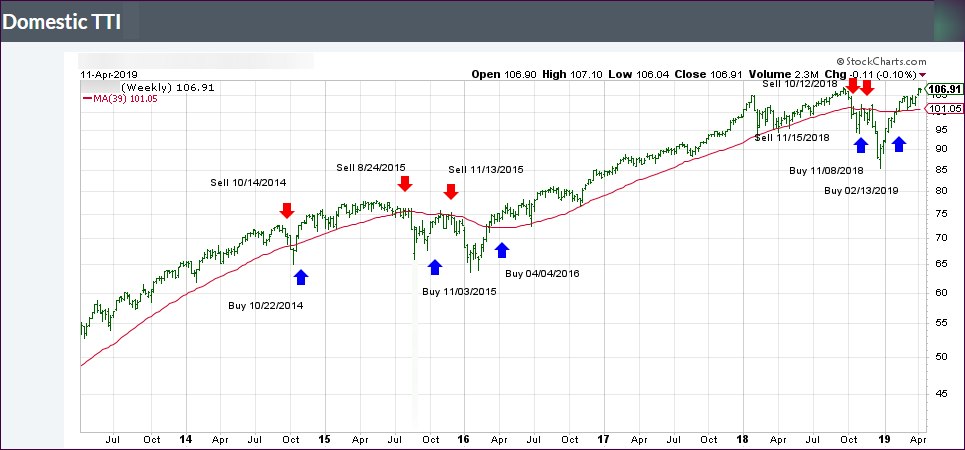
In my advisor practice, we will remain on the sidelines until this bear market has run its course rather than trying to be a hero and catch the proverbial falling knife. Our Domestic Trend Tacking Index (TTI) remains firmly entrenched on the bearish side of its trend line by a substantial -10.17%. Bearish tendencies may have a way to go, and we don’t want any part of it.

Read More

Weekly StatSheet For The ETF Tracker Newsletter – Updated Through 12/27/2018

Ulli ETF StatSheet Contact

ETF Data updated through Thursday, December 27, 2018

Methodology/Use of this StatSheet:

  1. From the universe of over 1,800 ETFs, I have selected only those with a trading volume of over $5 million per day (HV ETFs), so that liquidity and a small bid/ask spread are assured.
  2. Trend Tracking Indexes (TTIs)

Buy or Sell decisions for Domestic and International ETFs (section 1 and 2), are made based on the respective TTI and its position either above or below its long-term M/A (Moving Average). A crossing of the trend line from below accompanied by some staying power above constitutes a “Buy” signal. Conversely, a clear break below the line constitutes a “Sell” signal. Additionally, I use a 7.5% trailing stop loss on all positions in these categories to control downside risk.

  1. All other investment arenas do not have a TTI and should be traded based on the position of the individual ETF relative to its own respective trend line (%M/A). That’s why those signals are referred to as a “Selective Buy.” In other words, if an ETF crosses its own trendline to the upside, a “Buy” signal is generated. Since these areas tend to be more volatile, I recommend a wider trailing sell stop of 7.5% -10% depending on your risk tolerance.

If you are unfamiliar with some of the terminology, please see Glossary of Terms and new subscriber information in section 9.


  1. DOMESTIC EQUITY ETFs: SELL — since 11/15/2018

 Click on chart to enlarge

Our main directional indicator, the Domestic Trend Tracking Index (TTI-green line in the above chart) is now positioned below its long-term trend line (red) by -10.64% after having generated a new Domestic “Sell” signal effective 11/15/18 as posted.

Read More