Netflix Boosts The Markets

Ulli Market Commentary Contact

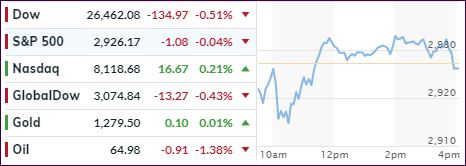
[Chart courtesy of MarketWatch.com]
  1. Moving the markets

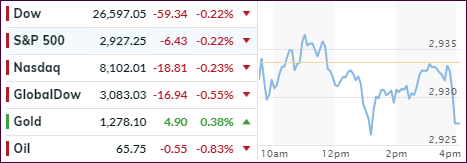
Netflix was the major driver to get things started in the bullish direction and kept things alive throughout the session, despite earnings growth estimates having fallen recently to less than half the average growth for the first three quarters.

However, that did not matter, what was most important was that Netflix’s price hike prompted buying throughout the session with the Nasdaq benefiting the most. The fly in the ointment was Senator Grassley’s remark that there was “little progress” in the China talks as well as the “failed” Brexit amendment vote.

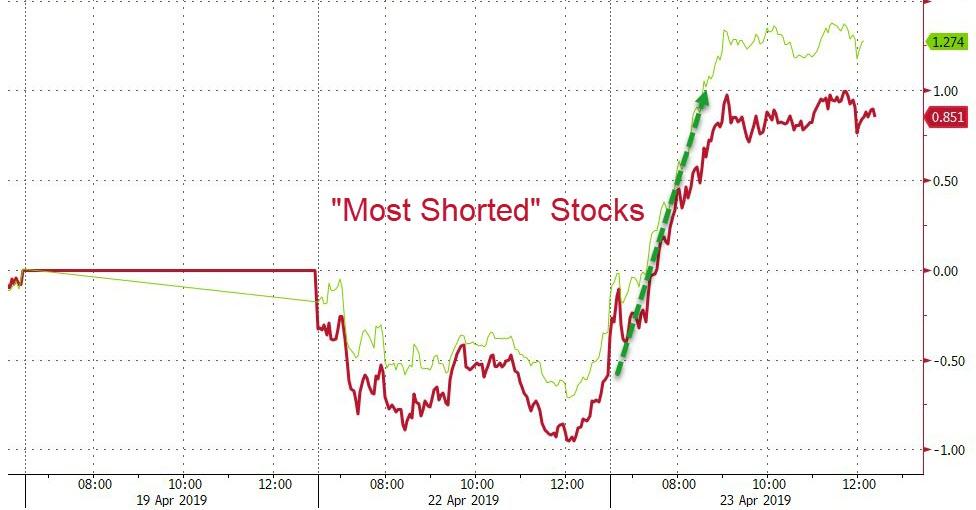
Even JP Morgan’s earnings disappointment did nothing to stop the computer algos from ramping things higher. In graphic form, you can see the effect on the markets here. So far, early announcements about future guidance was ignored, as first Apple, then Delta, Barnes & Noble, Macy’s, American Airlines, Alibaba and now Goodyear Tire have all slashed their outlook.

As more guidance cuts, like the above ones, make companies tell the truth about economic reality, Morgan Stanley may be right with their proclamation that we will soon see an earnings recession rather than an earnings season.

Hmm, makes me wonder if the computer algos are programmed to deal with that scenario.

Read More

Global Growth Fears Keep Bullish Tendencies In Check

Ulli Market Commentary Contact

[Chart courtesy of MarketWatch.com]
  1. Moving the markets

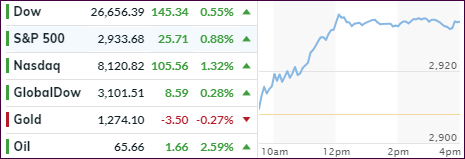
An early sharp drop gave way to a bounce throughout the session, but conviction was lacking in the face of ugly China trade data, and by association, more concerns again over a general global slowdown.

Adding to the uncertainty was the beginning of earnings season, which many analysts view with some skepticism after a mixed Q4 2018, during which the S&P 500 got clobbered at the rate of -14%. Citi Bank started things out, was bashed at first due to disappointing revenues, but recovered and rallied.

Still, much of today’s early damage was wiped out when Trump threw an assist by proclaiming “very good China talks,” which has been a reliable standby for months to prop up the markets. They did rally, but not in convincing fashion as the major indexes still ended up with losses for the day.

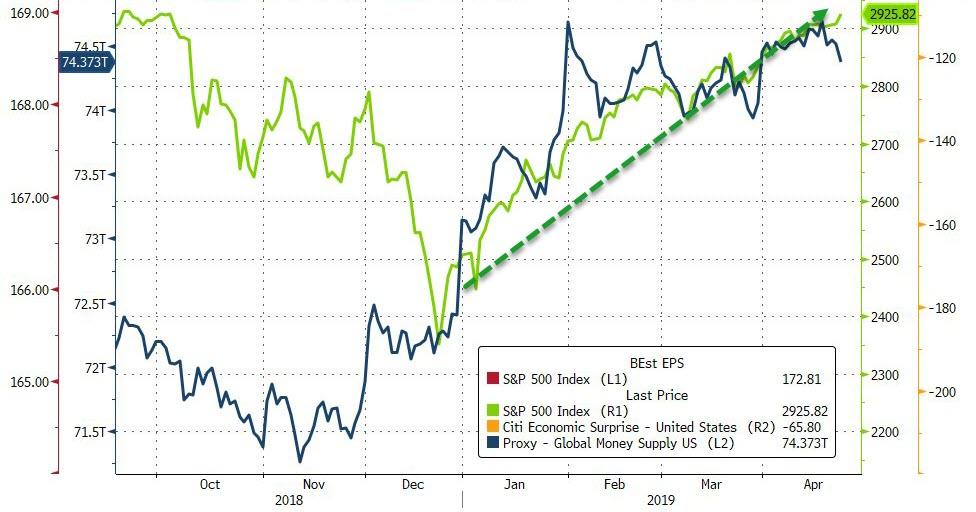
In regard to earnings, forward expectations are disconnected from the S&P 500, as this chart (thanks to ZH) shows. That leaves the question wide open as to which direction the eventual “connect” will occur, which in turn will then give some clue as to who will dominate soon: Will it be the bulls of the bears?

We should find out within the next few weeks.

Read More

ETFs On The Cutline – Updated Through 01/11/2019

Ulli ETFs on the Cutline Contact

Below, please find the latest High-Volume ETF Cutline report, which shows how far above or below their respective long-term trend lines (39-week SMA) my currently tracked ETFs are positioned.

This report covers the HV ETF Master List from Thursday’s StatSheet and includes 322 High Volume ETFs, defined as those with an average daily volume of more than $5 million, of which currently 60 (last week 53) are hovering in bullish territory. The yellow line separates those ETFs that are positioned above their trend line (%M/A) from those that have dropped below it.

Take a look:

The HV ETF Master Cutline Report

In case you are not familiar with some of the terminology used in the reports, please read the Glossary of Terms.

If you missed the original post about the Cutline approach, you can read it here.

ETF Tracker Newsletter For January 11, 2019

Ulli ETF Tracker Contact

ETF Tracker StatSheet

https://theetfbully.com/2019/01/weekly-statsheet-for-the-etf-tracker-newsletter-updated-through-01-10-2019/

SNAPPING THE WIN STREAK BUT GAINING FOR THE WEEK

[Chart courtesy of MarketWatch.com]
  1. Moving the markets

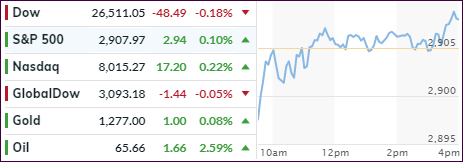
Today was almost a repeat from yesterday’s session in that we started sharply to the downside, but bullish momentum appeared and pulled the major indexes up, but they fell a tad short of crossing above the unchanged line.

For the week, the Dow gained 2.4%, the S&P 500 ended up 2.5% while the Nasdaq took top billing with +3.5%. While these were nice advances, remember that they are not actual gains but merely represent a making up of some of the losses sustained by the Buy-and-Hold crowd, since our last Sell signal became effective on 11/15/18.

Since that date, the S&P 500 (SPY), for example, is still down -5.14%, which means that this exact percentage gain is required for those who stayed invested to get back to “even” when compared to the Trend Tracking strategy. So, the headlines that “the stock market just got off to its best start in 13 years” conveniently forgets that Q4 2018 was on the of the worst ever with the S&P 500 surrendering -14% thereby neutralizing the effect of this “best start.”

Potential bull markets start in bear market territory and vice versa meaning that the rebound of the last few weeks should come as no surprise.  Slumping macro data, tumbling earnings expectations and the Fed’s balance sheet reductions, however, are headwinds that computer algos, who control most of the trading, simply ignored but which still need to be dealt with.

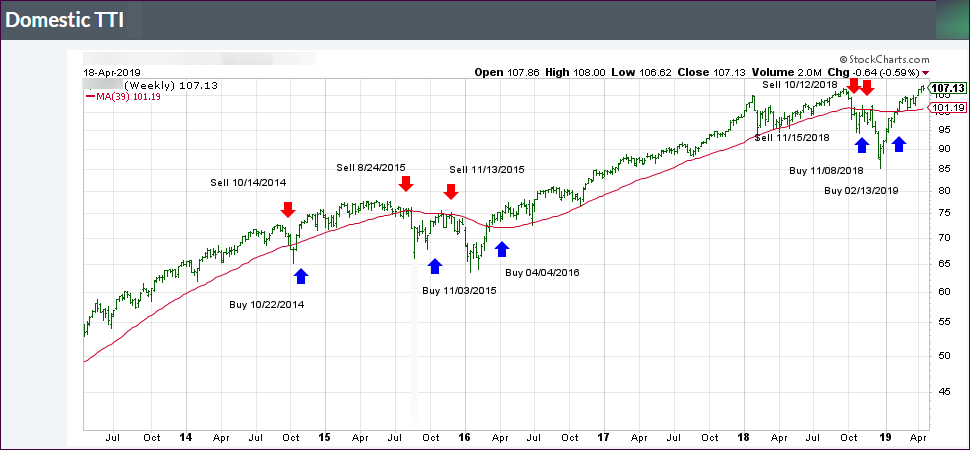
However, it’s questionable at this moment in time whether there are enough catalysts available to keep upward momentum going to a point, where a new bull market starts and our Trend Tracking Indexes (TTIs) give the go ahead. Right now, it would take another +5% advance of our Domestic TTI to cross above its long-term trend line.

With the markets see-sawing and moving violently daily, any outcome is possible, no matter how unlikely or improbable. The current positive market theme could continue or end with a sudden bang. No one has the answer, despite many MSM headlines proclaiming that they do. It’s best not to get suckered into making emotional decisions, which for me means tracking our TTIs and waiting patiently for a new “Buy” signal to develop.

Read More

Weekly StatSheet For The ETF Tracker Newsletter – Updated Through 01/10/2019

Ulli ETF StatSheet Contact

ETF Data updated through Thursday, January 10, 2019

Methodology/Use of this StatSheet:

  1. From the universe of over 1,800 ETFs, I have selected only those with a trading volume of over $5 million per day (HV ETFs), so that liquidity and a small bid/ask spread are assured.
  2. Trend Tracking Indexes (TTIs)

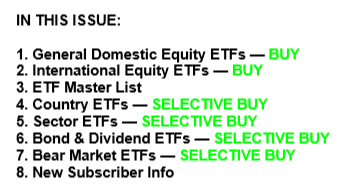
Buy or Sell decisions for Domestic and International ETFs (section 1 and 2), are made based on the respective TTI and its position either above or below its long-term M/A (Moving Average). A crossing of the trend line from below accompanied by some staying power above constitutes a “Buy” signal. Conversely, a clear break below the line constitutes a “Sell” signal. Additionally, I use a 7.5% trailing stop loss on all positions in these categories to control downside risk.

  1. All other investment arenas do not have a TTI and should be traded based on the position of the individual ETF relative to its own respective trend line (%M/A). That’s why those signals are referred to as a “Selective Buy.” In other words, if an ETF crosses its own trendline to the upside, a “Buy” signal is generated. Since these areas tend to be more volatile, I recommend a wider trailing sell stop of 7.5% -10% depending on your risk tolerance.

If you are unfamiliar with some of the terminology, please see Glossary of Terms and new subscriber information in section 9.


  1. DOMESTIC EQUITY ETFs: SELL — since 11/15/2018

Click on chart to enlarge

Our main directional indicator, the Domestic Trend Tracking Index (TTI-green line in the above chart) is now positioned below its long-term trend line (red) by -4.89% after having generated a new Domestic “Sell” signal effective 11/15/18 as posted.

Read More

A Wild Ride: Dump, Pump, Dump And Pump

Ulli Market Commentary Contact

[Chart courtesy of MarketWatch.com]
  1. Moving the markets

It was another wild ride in the markets when, after an opening dump, dip-buyers (or was it the PPT?) stepped in and pushed the major indexes slowly but surely back above the unchanged line, when another dive pulled them back below it, before a second rebound shoved them into green for a fifth straight day of gains.

Of course, no other event than Fed head Powell speaking can put markets in a tizzy fit like we saw today. He started with “patient,” which worked well for stocks but, then caused a pullback after uttering that the Fed’s balance sheet would be “substantially” lower. Translation: Quantitative Tightening (QT) is still alive. In graphic form, ZH presented it best in this chart.

Nothing else seemed to matter today, as even consumer related headlines were simply ignored. First, there was Macy’s record drop, which had the S&P Department Stores index gasping, as it went into freefall. Not to be outdone, the S&P airline index followed suit, except here the dip-buying crowed stepped in to make this wild ride a non-event, but the move demonstrated that all is not well in consumer land.

And again, ZH took top billing with this chart showing the current divergence between the S&P 500 and its forward EPS (Earning per share). Some analysts have called this rebound a bull trap, meaning this is simply an interruption in an ongoing bear market.

Our Domestic Trend Tracking Index (TTI) confirms that view, at least for the time being, as it is still positioned -4.89% below its long-term trend line.

Read More