Equities Get Crushed—Dow Loses The 20,000 Level

Ulli Market Commentary Contact

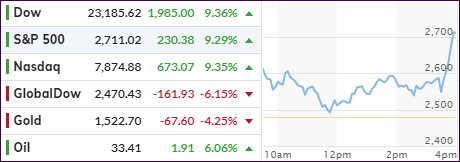
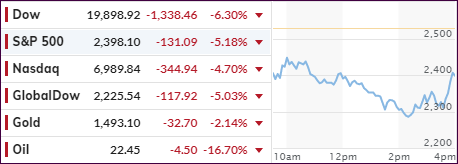
[Chart courtesy of MarketWatch.com]
  1. Moving the markets

So much for yesterday’s rebound of “hope,” which got annihilated, as the major indexes took another step down. At one point, the Dow even lost its 19k level, while the S&P dropped below 2.3k, but both were pushed back up thanks to a bounce off their lows during the past 30 minutes.

Those buy-and-holders, which were hoping for the bond portion of their portfolios to bail them out, were disappointed again, as yields rose, with the 10-year being up almost 11 basis points to 1.19%, thereby exerting a double whammy loss on portfolios still exposed to this insanity.  

It’s no surprise that the cause of this upheaval is the fallout from the coronavirus, as nations are shutting down, major corporations and businesses struggling and looking for bailouts, while the banking sector is about to experience some major pain, and possible failures, as above businesses may not be able to survive a sharp drop in revenue, thereby increasing the possibility of defaults. Or, better said, bank failures may be on the horizon.

Of course, the underlying problems are the same we saw in 2008, as nothing has been fixed, with ZH summing up the problem like this:

And it may come as a shock to some, but ever since the financial crisis nothing has been actually fixed, and instead the Fed stepped in at every market stress event to inject more liquidity, aiding the issuance of even more debt, and kicking the can while helping mask the symptoms of the crisis, only made the underlying financial instability even more acute.

Meanwhile, conventional wisdom that the US banking system was rendered more stable now are dead wrong, with the public and countless financial professionals fooled by the nearly two trillion in excess reserves (we all saw what happened when this number dropped to a precarious “low” of “only” $1.3 trillion in September of 2019) injected by the Fed in recent years. All this liquidity upon liquidity has only made the system that much more reliant on the Fed’s constant bailouts and liquidity injections.

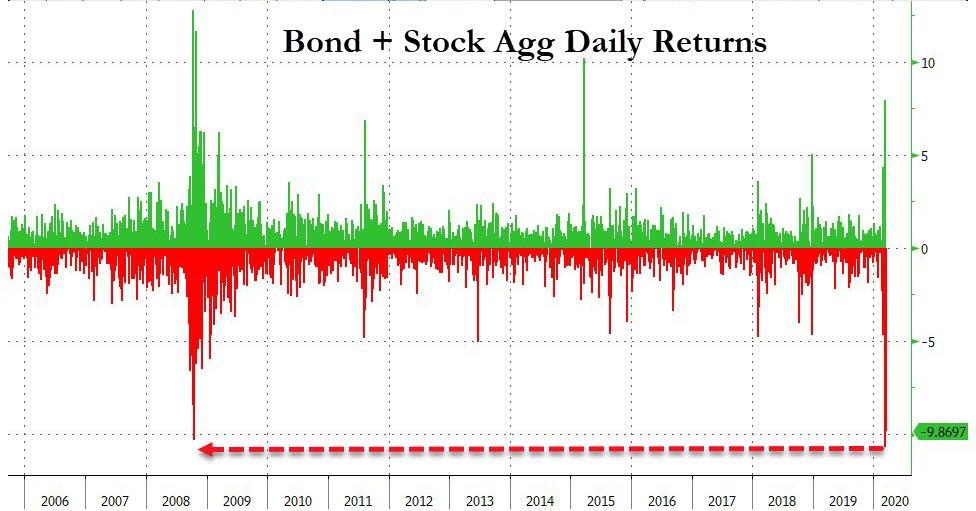
With market panic accelerating, and as I pointed out above, ZH confirmed that today was the worst day ever for a combined equity/bond portfolio, down -9.87%, as shown in Bloomberg’s chart.

The carnage may have a long way to go, so as trend trackers, we feel privileged to enjoy a front row seat on the sidelines.

Read More
Stimulus Hopes Pull Stocks Out Of The Doldrums

Ulli Market Commentary Contact

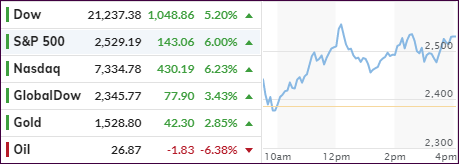
[Chart courtesy of MarketWatch.com]
  1. Moving the markets

Equities managed a nice bounce today powered higher by news that the Trump administration asked for a $1 trillion fiscal stimulus package to mitigate the fallout effects from the coronavirus. News that the Fed moved to support the commercial paper market via providing short-term funding needs, also gave an assist and elevated sentiment.

After getting slaughtered yesterday, the major indexes staged a nice rebound wiping out some of yesterday’s losses yet being far away from establishing a new bullish trend.

Some of the measures the government is evaluating to help combat the effects of the virus includes deferral of tax payments, sending checks directly to the populace, also known as helicopter money, and keeping the financial markets open and functioning.

Whether all these efforts will have the desired effect remains to be seen, especially on the Fed’s part, where despite intervention, banking liquidity worsened. At the same time, the 10-year yield spiked back above 1%, up a substantial 30bps from the lows of the day. Something still does not make sense in the overnight lending market.  

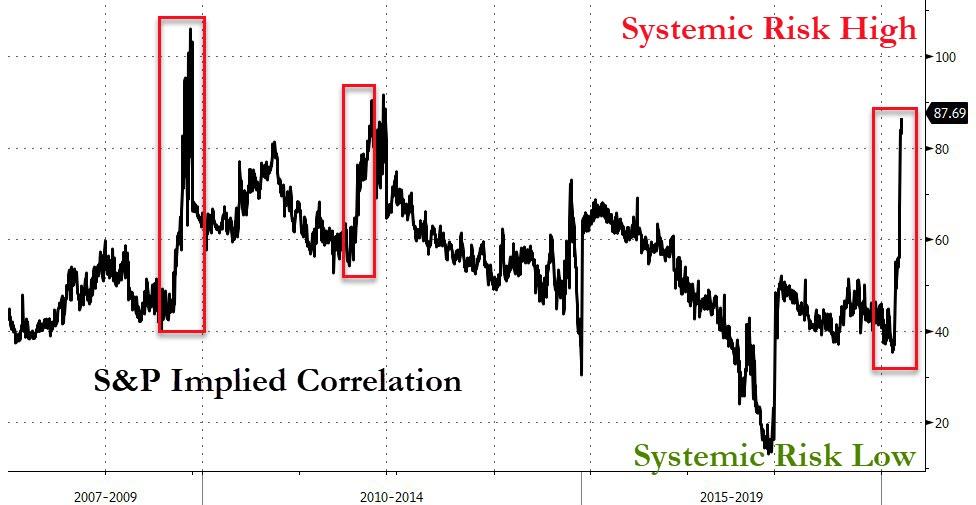
All this has affected equities, where we have witnessed 3%+ moves in the S&P 500 during 13 of the past 22 trading days, approaching the October 2008 experience, according to ZH. Systemic risk levels continue to soar, as Bloomberg points out here.

Safety is number one in my book where, during these trying times, the return of our capital ranks higher than the return on our capital.

Read More

Fed Unloads Its Biggest Bazooka Ever—Markets Crash—Dow Plunges 3,000 Points

Ulli Market Commentary Contact

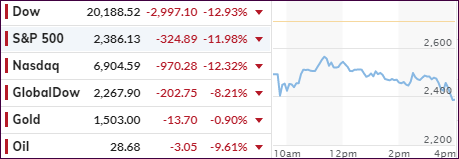
[Chart courtesy of MarketWatch.com]
  1. Moving the markets

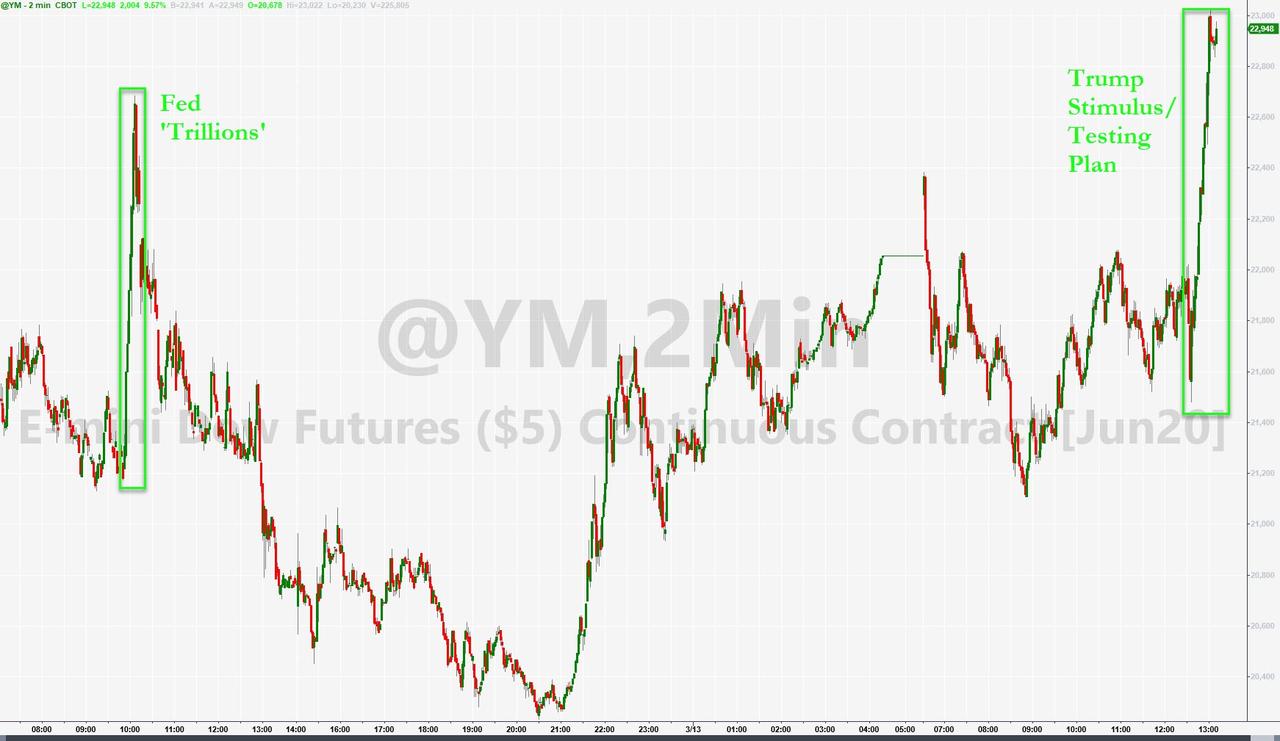
When I was watching the futures markets last night, I already knew that today would not be a good one to be in the markets. Despite the Fed unloading its biggest emergency bazooka ever, by announcing $700 billion in QE and a full 1% reduction in interest rates to “zero,” markets immediately went limit down.

We all know that the Fed’s FOMC meeting was scheduled for this coming Tuesday/Wednesday, and they could not wait 3 extra days to announce their decision?

So, they rushed to do it Sunday night just prior to the futures markets opening. This smelled like a panic move, and the markets took it as such and started the session limit down.

This morning, things did not look better, and the circuit breakers kicked in, as @GreekFire23 summed up:

  1. 9:30am: Ding Ding Ding! Trading open!
  2. 9:30:00001am: Halted

That represents the speed with which we hit limit down. In other words, Friday’s much hyped rebound turned into another dead-cat-bounce, with the major indexes getting slaughtered today by dropping around -12% with the Dow being the worst performer with -12.93%, or just about -3,000 points.

Or, looking at it from another viewpoint, Small Caps and Transportations are down -35% from their highs, and the rest of the majors down around -27%, according to ZH.

We have now seen 2 massive global monetary interventions, and they resulted in a total bloodbath for the markets—and this may only be the beginning.

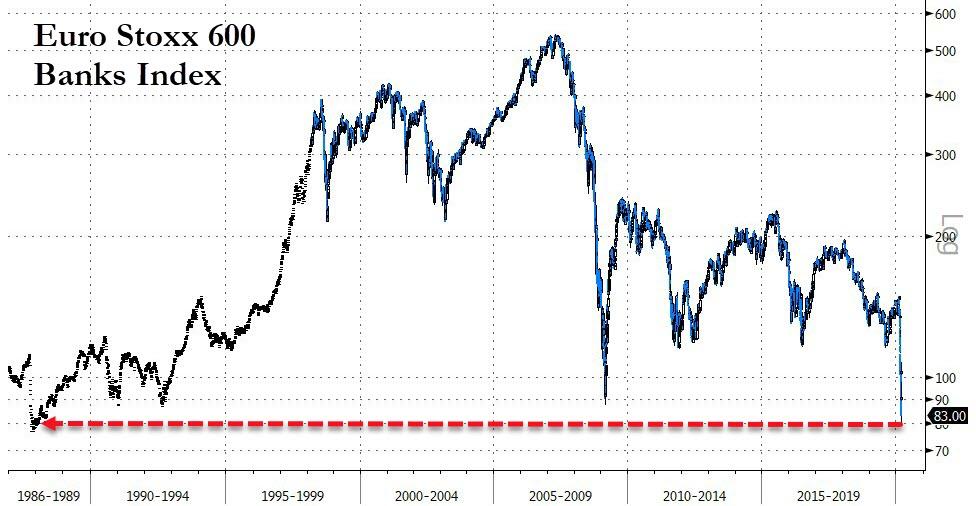
The carnage was worldwide, with banking stocks in Europe now smashed to a level last seen in 1987, as Bloomberg shows.

The question now is, will the December 2018 lows of the S&P 500 hold? If not, we are bound to go a lot lower.

I am sure, this week will have a lot more surprises in store with many Buy-and-Holders wishing that they had joined us on the sidelines on 2/27.

Read More

ETFs On The Cutline – Updated Through 03/13/2020

Ulli ETFs on the Cutline Contact

Below, please find the latest High-Volume ETF Cutline report, which shows how far above or below their respective long-term trend lines (39-week SMA) my currently tracked ETFs are positioned.

This report covers the HV ETF Master List from Thursday’s StatSheet and includes 322 High Volume ETFs, defined as those with an average daily volume of more than $5 million, of which currently 31 (last week 91) are hovering in bullish territory. The yellow line separates those ETFs that are positioned above their trend line (%M/A) from those that have dropped below it.

Take a look:                                                                   

The HV ETF Master Cutline Report

In case you are not familiar with some of the terminology used in the reports, please read the Glossary of Terms. If you missed the original post about the Cutline approach, you can read it here.      

ETF Tracker Newsletter For March 13, 2020

Ulli ETF Tracker Contact

ETF Tracker StatSheet          

You can view the latest version here.

ENDING A BRUTAL WEAK WITH A RELIEF RALLY

[Chart courtesy of MarketWatch.com]
  1. Moving the markets

The markets finally managed to keep a rebound rally going after yesterday’s collapse. As I posted, during bear markets, you can witness violent upswings, but they don’t mean the bearish trend is over.

Today, we started in the green, as news from Europe that the German FinMin unleashed their version of a financial bazooka and presented their “whatever it takes moment:”

  1. SCHOLZ SAYS POSSIBLE GERMANY WILL NEED TO TAKE ON ADDED DEBT;
  2. GERMANY WILL HAVE NO LIMIT ON CREDIT PROGRAM FOR COMPANIES;
  3. SCHOLZ SAYS GERMANY WILL SPEND BILLIONS TO CUSHION ECONOMY;
  4. GERMANY PLANS TO SET UP SAFETY NET FOR VIRUS-HIT COMPANIES;
  5. ALTMAIER: RESOURCES FOR GERMANY’S STATE BANK TO RISE TO 500BN

That set the bullish tone for the day, and up we went. Adding hope for a quick response domestically were reports that House Speaker Pelosi and the Trump Administration were nearing an agreement on an aid package, to include sick pay free virus testing and other resources.

Then it was the Fed’s turn to announce their “whatever it takes moment,” by attempting to restore some liquidity in the broken overnight lending market by concluding three of six emergency POMOs (Permanent Open Market Operations) and soaking up billions of Treasuries of varying maturities.

Towards session end, it was Trump’s stimulus/testing plan that spiked equities to their biggest gain since October 2008, thereby somewhat offsetting the market’s worst week since 2008, during which the S&P 500 dropped -8.8%.

Even diversification did not help, as this week was the worst weekly loss for a diversified portfolio of stocks and bonds since 2008 with -14.69%, as Bloomberg points out in this chart.

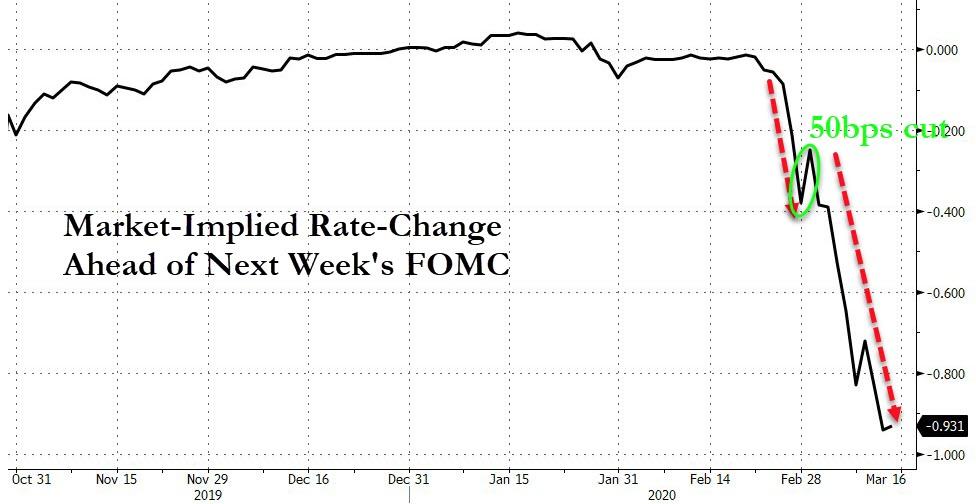
Next week, the Fed will meet, and the markets are “demanding” a full 1% interest rate cut with Bloomberg providing the graphic representation. You can be pretty much assured that the Fed will cave and comply, otherwise the current debacle will continue in an accelerated fashion.

Read More

Weekly StatSheet For The ETF Tracker Newsletter – Updated Through 03/12/2020

Ulli ETF Tracker Contact

ETF Data updated through Thursday, March 12, 2020

Methodology/Use of this StatSheet:

1. From the universe of over 1,800 ETFs, I have selected only those with a trading volume of over $5 million per day (HV ETFs), so that liquidity and a small bid/ask spread are assured.

2. Trend Tracking Indexes (TTIs)

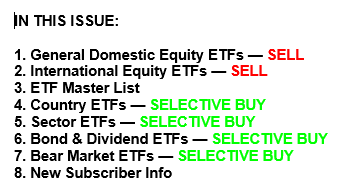
Buy or Sell decisions for Domestic and International ETFs (section 1 and 2), are made based on the respective TTI and its position either above or below its long-term M/A (Moving Average). A crossing of the trend line from below accompanied by some staying power above constitutes a “Buy” signal. Conversely, a clear break below the line constitutes a “Sell” signal. Additionally, I use a 7.5% trailing stop loss on all positions in these categories to control downside risk.

3. All other investment arenas do not have a TTI and should be traded based on  the position of the individual ETF relative to its own respective trend line (%M/A). That’s why those signals are referred to as a “Selective Buy.” In other words, if an ETF crosses its own trendline to the upside, a “Buy” signal is generated. Since these areas tend to be more volatile, I recommend a wider trailing sell stop of 7.5% -10% depending on your risk tolerance.

If you are unfamiliar with some of the terminology, please see Glossary of Terms and new subscriber information in section 9.     

1. DOMESTIC EQUITY ETFs: SELL — since 02/27/2020

Click on chart to enlarge

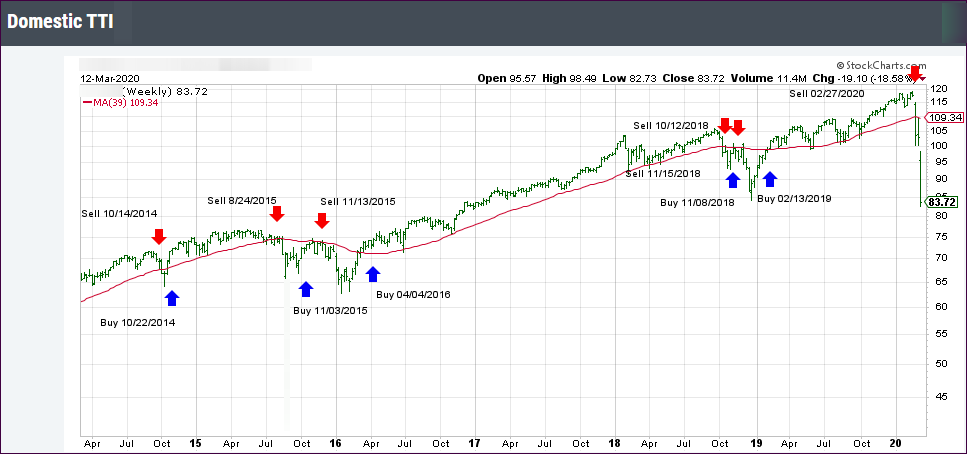
Our main directional indicator, the Domestic Trend Tracking Index (TTI-green line in the above chart) is now positioned below its long-term trend line (red) by -23.80% after having generated a new Domestic “Sell” signal effective 2/27/20 as posted.

Read More