 There are a few blogs that are on my daily read list because they offer unbiased advice about a variety of topics related to the economy. In terms of real estate, I enjoy Dr. Housing Bubble while in the finance and global economic events, I favor Mish Shedlocks’s Global Economic Trend Analysis.
Dr. Housing Bubble featured an interview with Mish, which is a worthwhile read, if you enjoy reading no-nonsense straight facts. Here are some highlights:
Peter Schiff has been arguing that we are heading toward inflation. You argue that we will see deflation. What are your thoughts regarding inflation and deflation?
Inflation is a net expansion of the money supply and credit. Deflation is the opposite, a net contraction of money supply and credit.
It is in the Fed’s best interest that people do not know what inflation is. That way, the Fed can talk about the price of oil, capacity utilization, productivity, and numerous other things while ignoring money supply. We have a Fed that sets monetary policy yet they talk about anything and everything but money! This is on purpose.
The bursting of the credit bubble and associated drop in prices of real estate has now permeated our economy. Banks and brokerage houses have written off hundreds of billions of capital. Citigroup was bailed out by Dubai and China. Merrill Lynch, Morgan Stanley, Lehman and others have received capital from China and Singapore. If I would have told you that US banks were going to be bailed out by Dubai, Singapore, and China two years ago you would have thought I was nuts.
Now capital impaired banks and brokerages are afraid or unwilling to lend. The municipal bond market has virtually shut down. The velocity of money is plunging. Liquidity is in hiding. Cash is being hoarded. These are deflationary conditions even though we have not yet seen a net reduction in overall credit.
What about gold and commodities?
Some point to gold as pointing toward inflation. From 1980 to 2000 we had positive inflation yet gold went from $800 to $250. If gold is predicting inflation, what exactly was it predicting from 1980 to 2000? Inflationists cannot explain this away.
The Kondratieff (K-Cycle) explains this all nicely. And as we enter K-Winter (deflation), gold should rise and interest rates fall. Gold is the only currency that has no associated liabilities. Its value stands to go up in deflation although I am open to the possibility of one more potentially large downdraft as deflation forces a reduction in leverage everywhere and the carry trade in Yen unwinds.
In the meantime, if gold is predicting anything at all, it is a further destruction of credit.
With that, I predict that more cuts are coming and we will see the Fed Funds Rate at 2 percent this summer. Inflationist models can’t explain 2 percent interest rates. My deflation model not only explains it, but predicts it.
What of Ambac and MBIA?
AAA or AA ratings on Ambac and MBIA are preposterous. Together they insure something like $150 billion in CDOs that are now worthless. They argue that they will not have to pay this out now, but rather over the next 30 years or whatever. While true on the surface, their argument does not hold water in terms of what their stock is worth. Net present value analysis of their assets and liabilities shows that Ambac and MBIA cannot survive without massive infusions of capital.
Warren Buffet essentially called their bluff by offering them reinsurance. I talked about this idea in Buffett’s Kiss of Death. The bottom line of this is that greed kills. Ambac and MBIA had a nice gravy train going but they wrecked it by getting away from their core business into insuring CDOs and other such nonsense.
How does Buffett’s offer influence a government bailout?
Buffet is looking to insure the municipal bonds for a fee. For someone well capitalized, this is likely to be a profitable business. More to the point, Buffett’s offer exposes MBIA and Ambac for the charlatans that they are. The monolines claim they do not want a bailout but the reality is they are begging Congress for that bailout.
The bailout comes from pleading for an AAA rating they clearly do not deserve. Any business that needs an AAA rating to stay in business is a flawed business right from the start. Worse yet, they jeopardized that rating willingly by diving into insurance on CDOs, and other derivatives they clearly did not understand.
By offering to insure the municipal bond portion of the business, Buffett has removed the argument that government needs to bailout the industry.
I’m looking at the profile of Ambac now and see that they have $1 billion in market cap and you mention that they have potentially $100 billion in bad debt. Am I reading this right?
You are reading things correctly. Not only are Ambac and MBIA leveraged to the hilt, they foolishly wandered into an even riskier business they did not remotely understand. Even without those CDOs, Ambac and MBIA would not deserve an AAA rating, just from the leverage factor alone!
The argument coming from the monolines is that the bad debt estimates are exaggerated and they can pay the claims off over time. While it is true that they do not have to take an upfront immediate hit on the entire CDO package they guaranteed, cash flow analysis suggests enormous problems.
With Buffett entering the municipal bond business, future cash flows to Ambac and MBIA will diminish from competition. Look at it this way: Would you rather have insurance from Buffett or from Ambac and MBIA whose guarantee is questionable at best and most likely worthless in practice?
What are your 2008 market predictions?
A massive consumer led recession will become so severe it will shock the bears.
People will continue to walk away from their homes.
All the housing bailout plans fail, one right after another.
Unemployment will skyrocket, ultimately hitting 6.5% to 7% as reported by the BLS. In actual practice, unemployment will be way higher.
Commercial real estate will undergo a massive implosion and capital impaired banks will not only stuck with huge numbers of houses but with commercial real estate as well.
Credit card defaults continue to soar.
Over the next couple of years, a dozen banks minimum will fail and most likely at least one big bank will fail. Commercial real estate will be the final straw for many banks.
Why are you so grim on corporate real estate?
Commercial real estate follows residential real estate with a lag. Miles and miles of strip malls were created, as subdivisions were overbuilt. There is rampant overcapacity everywhere.
We do not need more Pizza Huts, Home Depots, Lowes, nail salons, Wal-Marts, Targets, or anything else. With consumers going on strike, we need far less of what has actually been built. Lease rates will drop. Vacancies will soar. A cascade of defaults will flow starting from small stores going bust and ultimately leading to defaults by the mall owners who cannot make their mortgage payments. Already we are seeing huge numbers of store closings. I talked about that in Does the Shopping Center Economic Model Work?
Is the raise in caps by Fannie Mae and Freddie Mac simply a show or will it really help the market?
It’s a dog and pony show that’s all dog and no pony. If Fannie Mae and Freddie Mac start going after more high priced homes with an implied higher risk, they will need to spread the risk across all loans which may cause loan rates to rise across the board.
However, more than likely they won’t. Given the enormous declines in home values we have seen in California, Fannie and Freddie will not go plunging in. Neither will be willing to refi houses that are underwater. That alone knocks out a huge portion of the business.
Also keep in mind that lending standards have tightened. 0% down loans have vanished. Who in California can afford a home, including a substantial down payment, that wants a home and does not already have a home? The answer to that is virtually no one.
How does the US compare to Japan and the deflation they faced in the last decade?
Prices fell in Japan for 18 straight years even though there was nowhere in Japan to build. Yet we foolishly heard that San Diego, San Francisco and other such places would be immune because there was no place to build. That myth has clearly been shattered.
I have a chart that shows just how much further we have to go if we follow the path of Japan. Inquiring minds can find my most recent update in Housing Bottom Nowhere In Sight.
There are those who claim we cannot compare the US to Japan. I say “nonsense”. Differences between Japan and the US can easily be quantified. Furthermore, most of the differences increase the odds of deflation in the US, while others will speed up the timeline.
One of the biggest differences between Japan and the US is consumer debt. US consumers are far deeper in hock than Japanese consumers were. Debt is enormously deflationary in an environment where debt cannot be serviced. Global wage arbitrage enhances the problem.
First, we saw a massive outsourcing of manufacturing jobs. Now outsourcing is spreading to white collar work. For example, we can outsource X-rays to India where they will do the evaluation and diagnosis and send out a treatment plan back to the states. The treatment is done here, but much of what can be outsourced will eventually be outsourced. This puts enormous pressure on wages.
Some point out that “Japan is a nation of savers”. The striking thing about this argument is how foolish it is. Trends do not last forever. Consider the popping of the housing bubble! How many times did we have to listen to the NAR and the NAHB say housing always goes up, there is no national bubble and all kind of other nonsense? Now clowns are telling me that the trend of consumer spending in the US will last forever. Phooey.
A massive attitude change in the US is now underway. Boomers headed into retirement have reached the realization phase that housing prices will not go up forever, and will in fact decline. This puts a new light on the need to save. Indeed Changing Social Attitudes About Debt are right at the forefront of the deflation argument. Attitudes change first, then prices. For proof, think about the popping of the housing bubble in 2005. Suddenly, almost overnight people went from camping out overnight to buy Florida condos, to no lines and a glut of supply.
Only after attitudes changed did prices fall. It was slow at first then it picked up steam. A year later people were not only unwilling to buy houses, they were actually walking away from them. The national debate now is about the Moral Obligations Of Walking Away. And the trend continues to evolve as Businesses Are Advised To Walk Away.
With businesses walking away from stores, and consumers walking away from houses, and fewer new stores being built, where are the jobs going to come from? The long and short answers are both the same: There is no source of jobs. With no jobs, how are people going to pay debt back? Debt that cannot be paid back will be defaulted on. And that is deflation.
When do we reach the bottom?
I would expect 2012 to 2014 based on the analysis I presented in Housing Bottom Nowhere In Sight and When Will Housing Bottom. Essentially we are at least four years away from a bottom. California is 4 years off and Washington is 4 years off as well.
Some places like Florida (which was ground zero of the housing bust) may bottom earlier. Areas that didn’t experiences a boom like Detroit may just flat line for a few years. Places in small town USA may flatline as well. Vast areas in this country where there isn’t much real estate wealth may stay flat for a few years. But everywhere else there was a major bubble (all the major population centers), the bottom is still many years off.
Reports show the median price in Los Angeles County peaked in August of 2007 at $550,000. The median price is now $458,000. That is a 16 percent, $92,000 drop in 6 months. How low can we go?
Median prices can be misleading. For example, sales dried up at the lower end first, inflating median price. Some reports such as the Shiller Index and DataQuick show real prices are now down 16% in some California locations as well. However, such declines are dramatically understated because they do not include incentives and they only look at resales. As such, these reported 16 percent declines are a mere down payment as to what is going to happen.
I am now seeing advertisements from major California builders for up to 50% off new homes, in select locations. 50% off! Imagine you bought a home with 0% down two years ago for $500,000 and the builder is now offering the home for $250,000 or even $350,000. This is “reverse sticker shock” and fertile ground for more people with little skin in the game to decide to hell with it all and just walk away.
Do you have anything else you would like to add?
Yes, thanks. Things I am Told That Can’t Happen are now happening.
Obviously, I can’t be sure if all of these things will play out as Mish mentioned. However, it pays to be prepared and cautious in this uncertain environment when it comes to your investments. No matter what investments you may have or will buy in the future, never ever work without a trailing sell stop. Be big enough to take a small loss in order to avoid a devastating one.

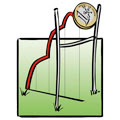
 I saw this picture sometime ago at Minyanville and thought it was hilarious given the current market environment.


