Touch And Go

Ulli Uncategorized Contact


Yesterday was a day of pondering in the markets, as concerns mounted about the possibility that the global recovery might be slowing down.

Inflation concerns in China and Great Britain occupied front page news followed by disappointing domestic retail sales in January.

Energy shares were a drag on the market, after Monday’s strong jump, following the theme that potentially slower sales growth will translate into less demand for energy products.

The beneficiary of the inflation fear story was gold, which headed higher for a second day in a row. Even though gold has been flat since the beginning of the year, it still should be an important component in an investor’s portfolio. Not only will inflation concerns in other parts of the world support its trend, so will sudden unexpected global uncertainties, which are sure to surface again.

While inflation is not a threat in the U.S. at this point, it sure is in other countries, such as China and Britain, among others. China reported a 4.9% inflation rate last month, which is about a 2-year high. Great Britain comes in at a close second with 4% followed by Spain with 3%.

Food prices have been rising around the world, which is represented by the fact that the commodity index (DBC) has risen sharply. While prices have not always been passed on to the end user yet, this development is worrisome in the sense that those with current high inflation rates will have to step on the economic brakes, so to speak.

Depending on the severity of the actions taken, that will not bode well for future global expansion and will eventually affect stock markets worldwide.

Disclosure: Holdings in DBC

Dip Buying Is Alive And Well

Ulli Uncategorized Contact

Despite elevated market levels, and fears of a correction, the dip buying mentality is alive and well as Reuters reports in “Buy That Dip, Baby:”

The new national pastimes are calling the top of the stock market, commenting on Middle Eastern affairs and — buying dips.

Stocks have shown remarkable resilience as investors snap up any drop in prices, even in the face of what seem like considerable risks — an overbought market and a still potentially explosive situation in the Middle East.

Confidence in the economy, strong earnings, and inflows into equities from bond funds have been enough to push indexes to new highs on an almost daily basis even if light volume and slight gains show investors are not making aggressive moves.

Robert Auer, a fund manager at SBAuer Funds in Indianapolis said that after eight months of outflows his Auer Growth Fund had started to see inflows.

“I’m wondering if this is happening at American Funds and Fidelity and everyone else,” he said. “I’m having to put it to work because we typically don’t hold any cash, so it is causing me to do buying.”

Bond funds have seen three months of outflows, the longest streak in more than 2 years.

Over that period $23 billion has moved out of bond funds while $16 billion has flowed into equity funds, according to data from the Investment Company Institute.

Rising yields have accompanied increasing optimism over the economy that will again be tested with retail sales and industrial output data during the week.

“Investors right now think the pullback is already here and they’re not buying stocks – and not selling but not buying at a time of inflows is forcing the market to drift higher,” said Thomas Lee, U.S. equity strategist at JPMorgan in New York.

Volume hit its lowest levels so far this year on Tuesday with just over 7 billion shares traded on the NYSE, Amex and Nasdaq compared to last year’s average of around 8.5 billion.

Lee is expecting a pullback in the March and April time frame, with the S&P; 500 rising to 1,333 before falling to around 1,250, taking the market back to where it was in late December.

“You really need to start buying at the 1,270 level,” he said. “You need to be selective and getting ready to buy that dip.”

The 1,333 level is the double-your-money mark from the bear market intraday low of 666.79 in March 2009 and is seen as a significant level by some investors.

[Emphasis added]

There you have it. 1,250 is the first number I have heard of where the eventual correction might end up, which is about a 6% pullback from current levels.

While buying dips in a bull market can have its obvious rewards, it only works….until it doesn’t. And that is the moment when a pullback turns into an actual trend reversal and market direction changes from bullish to bearish.

I for one will most certainly not rely on forecasts, like the above, by blindly using the 1,270 as a buy point. Make sure that the actual uptrend remains intact before deploying more monies in the market. That may cause you to enter at a slightly higher level, but you will have reduced downside risk considerably.

Sunday Musings: An All ETF 401k

Ulli Uncategorized Contact

It had to happen eventually. A major player would offer an all ETF 401k plan. While only very few custodians have ventured into that arena, Charles Schwab & Co. has announced that they are up to the task as well, as ETF Trends recently reported:

This news should cheer investors who want to see a wider array of all-exchange traded fund (ETF) 401(k) plans on the market: discount brokerage and ETF provider Charles Schwab is getting in on the action.

Schwab President and CEO Walter W. Bettinger II told a group of advisors recently that the firm has been hard at work on the launch of an all-ETF 401(k) plan in early 2012, says Lisa Shidler at RIABiz.

In keeping with Schwab’s low-cost ethos, its plan would save participants between 35% and 85% off a mid-sized plan, Bettinger said.

Schwab isn’t the first-mover in this growing space, but when the plan launches, it will be the biggest player by a long shot.

The move is huge for the ETF industry, which has been trying (and slowly succeeding) in cracking this market. There’s an estimated $3 trillion in 401(k) assets, and naturally, the ETF industry would like a bigger chunk of that.

The fear among naysayers has been that some 401(k) investors would trade all day, every day, but some employers may opt to limit such active trading if they add the plan to their rosters.

Schwab’s 401(k) plan is timely, since Congress has been closely eying the fees and expenses that mutual fund-based 401(k) plans charge. If Schwab can introduce a plan that saves people serious money, combined with the fact that ETF commissions are shrinking fast, the industry could be looking at moving well beyond its current $1 trillion in assets.

To me, it is not the old battle as to whether ETFs are a better investment than mutual funds. What it comes down is lower cost and less trading restrictions. Especially the latter has been a thorn in my eye for a long time.

I manage a few 401ks for clients, and the hoops I have to jump through to be sure I don’t rub the custodian the wrong way by making one too many portfolio adjustments are simply ridiculous and out of touch with reality.

I welcome this development and hope that other custodians will follow suit. After all, you as the plan participant are the one who stands to gain the most; and that’s what matters.

On Risk And Complacency

Ulli Uncategorized Contact

I don’t quote Barron’s very often, but they featured a nice piece on risk titled “That’s Better Now.” Let’s look at some highlights:

Investment success last year meant embracing risk. Certainly, it wasn’t hard to find.

Following 2009’s sharp rally, investors had to confront their fears about weak U.S. housing and employment, Europe’s ugly sovereign balance sheets, May’s violent flash crash, a sharp swing in U.S. political sentiment, deficit-ridden state and local governments, and the effects of easy U.S. monetary policy in order to partake in a second-half stock-market surge that many reasonable people mistrusted. Risk was rewarded.

In such an unpredictable year, the mutual-fund families that delivered the best overall returns for their shareholders didn’t take money off the table, flee to defensive stocks or hide in Treasury bonds. That made for some unusual winners in our annual ranking of the best fund families. A prime example is the leader of the Barron’s/Lipper ranking: Dimensional Fund Advisors, a quantitative-fund group with many index-like qualities. DFA was followed by Nuveen Fund Advisors, newcomer Principal Management, Oppenheimer Funds, and Waddell & Reed Investment Management.

Overall, they topped their rivals with strong returns in areas like emerging-market stocks, which were up 19.54%, small- and mid-cap growth and value plays, which gained 27.74% and 24.19%, respectively, and global high-yield funds, which rose about 3.50%, according to Lipper.

CAN MUTUAL-FUND FAMILIES and their investors continue to dodge the raindrops for another year? Not only are stocks at higher levels and bond yields still low, none of 2010’s risks have disappeared and a new one — political upheaval across the Mideast and North Africa — has appeared. The unrest in Egypt and elsewhere is a challenge for big oil companies that depend on the region for much of their supply, says Henry Herrmann, CEO of Waddell & Reed. And the worries about U.S. states and municipalities have worsened of late, driving $13.37 billion out of municipal-bond funds in December, a trend Degroot warns could continue.

“This could be the trend in the year ahead — risk on, risk off — with people thinking ‘the world is coming to an end’ or ‘maybe I’m missing the trend,’ ” observes Degroot.

Possibly a little late, retail investors seem to be getting their courage up to wade into U.S. stocks again. From Jan. 1 to Jan. 26 of the New Year, $11.82 billion flowed into U.S. large-cap growth and value equity funds, more than triple the $2.82 billion that went into international stock funds, according to Lipper. In 2010, $74.88 billion flowed out of U.S. stock funds, while $42.71 billion came into international stock funds, and a gargantuan $213.25 billion poured into taxable-bond funds.

Not everyone agrees that risk levels are rising: “The risky stuff is more stable this year,” says Art Steinmetz, chief investment officer of Oppenheimer.

“Appetite for risk will work until it doesn’t,” adds Jeff Tjornehoj, senior research analyst at Lipper in Denver. “The time to take risk is when people are absolutely scared out of their minds.” That time may have passed.

[Emphasis added]

There is much more to this article so check out the link if this interests you. I think the last paragraph above sums it up nicely. Risk has clearly increased with the major indexes hovering at these multi-year high levels.

I have repeatedly said that no portfolio growth has really been accomplished since June 2008, because the past 2-1/2 years have been spent making up losses—nothing else.

Of course, we could march even higher from here although the markets are priced to perfection as are expectations of future economic developments. Add to that the usual menu of potential global uncertainties, and I have to question whether this rally will end well.

For a better and well researched historical perspective, Mish at Global Trends wrote a fine article on the subject, which you can read here. It’s a bit lengthy but well worth your time.

No Load Fund/ETF Tracker updated through 2/9/2011

Ulli Uncategorized Contact

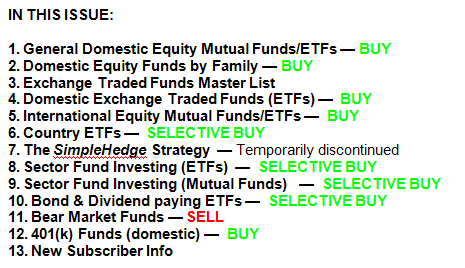
My latest No Load Fund/ETF Tracker has been posted at:

http://www.successful-investment.com/newsletter-archive.php

Continued upside momentum pushed the major indexes to another winning week.

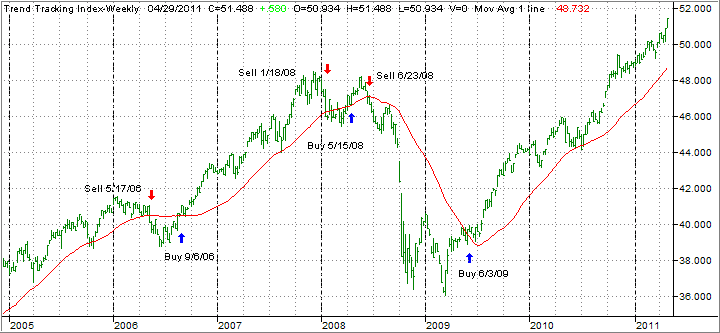
Our Trend Tracking Index (TTI) for domestic funds/ETFs has moved above its trend line (red) by +5.47% (last week +4.85%) and remains in bullish mode.

The international index has broken above its long-term trend line by +9.08% (last week +9.25%). A new Buy signal was triggered effective 9/7/10. If you decided to participate, be sure to use my recommended sell stop discipline.

[Click on charts to enlarge]

For more details, and the latest market commentary, as well as the updated No Load Fund/ETF Tracker StatSheet, please see the above link.

Short Post

Ulli Uncategorized Contact

No post today, since I finally had my long overdue cataract surgery done. It turned out to be successful, but my vision is still a little blurry, which makes reading and writing a bit of a challenge.

I should be back to normal within a day and plan on sending out Friday’s weekly newsletter as usual.