Equity ETFs Get a Rude Wake Up Call Amid European Woes

Ulli Market Review Contact

[Chart courtesy of MarketWatch.com]

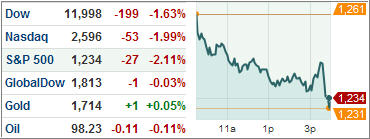
After days of relative inactivity, markets finally erred to the downside as news coming out of the EU summit highlighted the difficult landscape that Europe continues to face.  The S&P 500 fell 2.11% while European indices dropped as well. For instance, France’s CAC 40 experienced a 2.53% dip.

For the first time in a couple weeks, the VIX had a large upswing, jumping 6.70% to end above the 30 level once more. And in line with heightened risk, the 10-year Treasury rate dropped 2.23% to yield 1.97%. Commodities also took a hit today with gold and oil falling 1.90% and 2.45%, respectively. In essence, bad news finally seeped into global markets.

As EU leaders met in Brussels today to kick off the EU summit, the outlook isn’t getting any better. There’s significant concern around whether treaty changes can be agreed upon by all Eurozone members and be fully implemented.

Additionally, uncertainty looms in relation to whether the Eurozone will combine the EFSF and ESM to create a massive bailout fund. “Uncertainty” is becoming a dirty word that can only continue to arouse fears that Europe doesn’t have a long-term solution in place.

Read More

Major Market ETFs Anchored in Uncertainty Ahead of EU Summit

Ulli Market Review Contact

[Chart courtesy of MarketWatch.com]

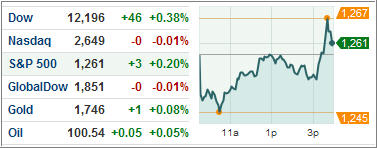
In yet another flat day on Wall Street, the S&P 500 trudged forward only 0.20% with other indices following suit in terms of minimal price volatility. The VIX only rose 2.60% today in what has been a quiet week to say the least.

Meanwhile, the dollar remained unchanged against the Euro at $1.34/Euro while commodity action was relatively minimal. With the EU summit coming up tomorrow, markets will probably start making some larger magnitude moves once some concrete news starts coming out.

Ahead of the EU Summit, the G20 is planning on instituting a bailout fund via the IMF to aid Europe. The proposed plan is a $600 billion lending facility. Now that Germany has expressed discontent over combining the EFSF and ESM bailout funds, the Eurozone’s going have to start getting creative if it wants to get out this mess. The fact that there’s nothing resolute continues to leave me skeptical of whether the Eurozone situation can turn for the better soon.

Read More

7 ETF Model Portfolios You Can Use – Updated through 12/6/2011

Ulli Model ETF Portfolios Contact

While the S&P 500 made up lost ground during the past 5 trading days by gaining +5.27%, our portfolios lagged but most are still ahead on a YTD basis.

The reason is, of course, that we remain underinvested in equities at this time, after huge drops in the recent past have stopped us out of most holdings. To me, upside momentum is still not convincing enough to take on greater risk.

Even though our Domestic TTI (Trend Tracking Index) has climbed above its long-term trend line by +2.94%, developments in Europe, especially the upcoming EU summit, is bound to have an effect on market direction. There will be either disappointment or euphoria.

I continued to sing the same old song about capital preservation, since I believe the downside risk is far greater than upside potential.

Take a look at the latest update:

Read More

Which Way Will ETFs Go? – Markets Stuck in the Middle

Ulli Market Review Contact

[Chart courtesy of MarketWatch.com]

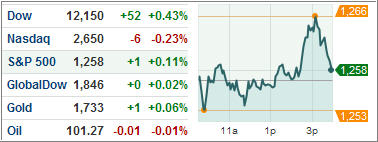
Despite some warnings yesterday concerning Eurozone downgrades, major market ETFs seemed relatively unaffected. The S&P 500 bumped up a paltry 0.11% as volatility remained minimal once more as the VIX rose only 1.04%.

Once again, the dollar/Euro exchange rate barely moved while commodities such as gold and oil were pretty flat. Although we haven’t seen massive daily drops lately, I wouldn’t bet against the fact that downward market pressure is likely in the coming weeks.

Ahead of the EU summit later this week, there are now talks that the Eurozone is considering some new options to boost its financial firepower. In light of difficulties to leverage the $590 billion EFSF, EU leaders are considering combining the EFSF and the ESM, the latter of which was supposed to succeed the EFSF on a long-term fund. In effect, this would double the amount of funds available. Clearly, the Eurozone realizes it’s on the cusp of financial disorder and must come up with a solution very quickly.

Read More

Equity ETFs in the Green Again – Is this Short-Term Equity Rally For Real?

Ulli Market Review Contact

[Chart courtesy of MarketWatch.com]

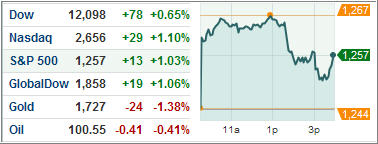
European fears have appeared to temporarily subside as markets pushed upwards once more, building off of last week’s big gains as the S&P 500 finished up 1.03%. This positivity was also echoed by European indices. Nevertheless, the Euro remained virtually unchanged against the dollar at $1.34/Euro.

Meanwhile, the Volatility Index had another quiet day, inching up 1.16% to finish at 27.84. Though there has been some market settling, we certainly aren’t in risk-off mode. If anything, the reduction in volatility merely makes for a slightly easier entry point to gain the selective equity ETF exposure that I’ve previously alluded to.

Market optimism aside, Standard and Poor’s is to announce widespread ratings downgrades for Eurozone countries, with France and Germany in serious doubt of keeping their AAA credit ratings among other countries. While this unofficial news didn’t seem to jeer investors today, actual actions taken may soon inject worry.

Read More

12-05-2011

Ulli Newsletter Archives Contact

The ETF/No Load Fund Tracker—Monthly Review—November 30, 2011
Markets Remain Confused

To put it mildly, November has been a topsy-turvy month for global markets. Although the S&P 500 only dropped 0.7% during the month, it was saved from a potentially disastrous monthly performance due to seemingly unjustified exuberance in the last few days of the month after a couple rough weeks.

Despite some appreciation in equities toward the end of the month, there is still a significant amount of volatility in the market given continued uncertainty about Europe’s bailout plans and signs of the contagion spreading. High bond yields in excess of 7% in Italy and Spain have exacerbated the debt crisis, increasing the probability of Eurozone disintegration.

With the exception of international equity ETFs and some bear market funds, I’m still adhering to my buy signal on a relatively selective basis depending on the attractiveness of certain ETFs. But in light of this volatile environment, I’ve still maintained a consider bond ETF allocation in addition to some PRPFX. With the negativity surrounding Europe and little improvement in the U.S., the key is to have a primarily defensive strategy in case the market’s bottom falls out.

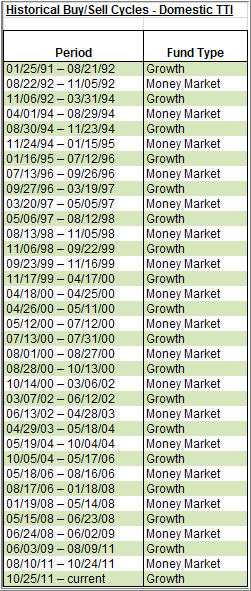
Nevertheless, our Domestic TTI (Trend Tracking Index) finished the month above its long-term trend line at +2.64%, after briefly sinking below it, warranting some select equity ETF exposure where deemed appropriate. See chart below:
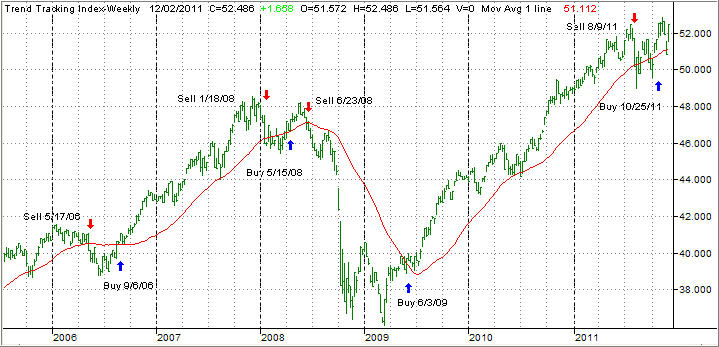
[Click on chart to enlarge]

As far as equity ETFs, we are sticking to Consumer Staples Select SPDR (XLP), which has held up relatively well as it isn’t as sensitive to major market movements.

This week’s coordinated action among major central banks provided some much needed liquidity to Europe’s banks, offering some short-term optimism. However, it can’t hide the fact that the European banking system is still under major duress while governments need ECB intervention to keep bond yields from spiraling further out of control. Even Germany, the beacon of hope for the Eurozone, faced difficulties selling bonds last month.

Furthermore, it has been doubtful whether the EFSF can be leveraged to the level it needs to provide sufficient aid to ailing countries. While Greece is a basket case that needs to exit the Eurozone, the possibility of a disorderly default in Italy and perhaps Spain would create a market pandemic.

In the case of Italy, debt restructuring in the vein of Greece’s bond haircut has been thrown around as a serious option given the futility of austerity measures.

To get a clearer idea of where the Eurozone is headed, we’ll be looking to the EU summit on December 9. Hopefully, there will be some resolution regarding Greece’s fate and efforts to obtain external bailout funding seeing as the Eurozone has proven unable to help itself.

And while Europe’s stuck in a rut, the U.S. situation isn’t much better. Weak housing data and mixed jobs numbers are pushing the need for additional quantitative easing as suggested by some members of the Fed. Plus, the political deadlock from the “Supercommittee” regarding the budget deficit has only worsened the situation.

Though global markets may have been somewhat impervious to the threat of contagion at times, Asian and emerging markets are especially susceptible to a Eurozone meltdown. A market dive can severely hamper these regions that are reliant on European banks for a considerable percentage of loans and other types of crucial funding.

As seen towards mid-to-late November with greater demand for U.S. Treasuries, we may see investors taking refuge in U.S. government bonds if Europe can’t reverse its fortune. Not to mention, the Euro mildly depreciated against the dollar in November if that’s a telling sign.

Currently, there is little to no indication as to where markets will trend on a week to week basis. Yet, the long-term picture suggests a period of significant adversity on a global scale despite our Domestic TTI still hovering in bullish territory.

Thus, the focus is to protect ourselves from an impending steep drop. Having a disciplined trailing sell stop strategy is an effective and efficient way to achieve this goal.