Are Country ETFs Worth the Investment?

Ulli ETF News Contact

As the whole world seems to have turned upside down in a financial sense, it nevertheless beckons the question of whether opportunities still exist in some parts of the globe.

Although the U.S., Europe, and parts of Asia are going through difficult times to say the least, there are other regions which have appeared to do well on a short-term basis such as Latin America.

However, that’s not to say that effects of the European contagion can suddenly infect emerging markets partially dependent on European financing. We only have to look to U.S. Treasuries to see that investors worldwide are flocking to them during periods of great uncertainty.

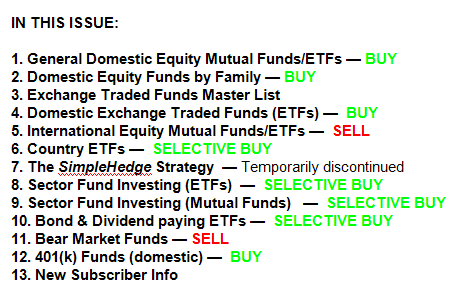
We currently have country ETFs listed as a selective buy, but there are still inherent risks. Achieving diversification is difficult without purchasing a number of country ETFs from various regions. Meanwhile, Country ETFs are sensitive to political risk, especially as we saw last year in the Middle East with the Arab Spring, which led to significant volatility in Middle Eastern markets.

Read More

01-06-2012

Ulli Newsletter Archives Contact

ETF/No Load Fund Tracker Newsletter For Friday, January 6, 2012

ETF/No Load Fund Tracker StatSheet

————————————————————-

THE LINK TO OUR CURRENT ETF/MUTUAL FUND STATSHEET IS:

https://theetfbully.com/2012/01/weekly-statsheet-for-the-etfno-load-fund-tracker-newsletter-updated-through-01052012/

————————————————————

Market Commentary

Friday, January 6, 2012

POSITIVE JOBS NUMBERS ARE NOT ENOUGH TO PUSH UP MAJOR MARKET ETFS

Although unemployment fell to a 3-year low today, it didn’t do much to catapult markets as the S&P 500 fell 0.25%. However, the NASDAQ had its best week in 6 weeks.

Not only did tech stocks have a great week, but so did financials, which took a drubbing in 2011. For instance, Financial Select Sector SPDR (XLF) gained 3.2%.

As seen with the Euro dropping to $1.27/Euro, European discord still reigns supreme as the driving factor on investors’ minds and as indicated by PIMCO’s Mohamed El-Erian, who believes Europe is at a turning point to try and save itself. Furthermore, the 10-year Treasury dropped to a yield of 1.96%, illustrating the fear of European contagion spreading.

The major news of the day was the decrease in the unemployment rate to 8.5%. According to the U.S. Department of Labor, 200,000 jobs were added, surpassing expectations.

This is surely a positive trend, but there are still a significant number of part-time workers and marginally attached workers. Also, the labor force participation rate remains low at 64.0%. See the Bureau of Labor Statistics report for more specific info.

With housing a major concern as well, the Fed has suggested exploring alternative measures to improve the housing market. Seeing as zero-interest rates still have failed to boost the economy, Bernanke is coming to grips with the need for other solutions.

High borrowing costs in Italy are now raising questions about whether Italy can stay afloat financially. With its 10-year now at 7.09% and over $2 trillion in debt, I’m afraid that a bailout on top of austerity measures will not be sufficient. Italy may arguably be too big to fail but it may also be too big to bail at the detriment of other Eurozone members.

Looking at Europe as a whole, the 4th quarter will probably be another disappointment. Despite the holiday season, retail sales and consumer confidence fell. Whether the recent ECB measures to boost bank lending can help spur the economy is the big unknown.

Today’s unemployment figures are a glimmer of hope, but Europe is without a doubt the most pressing concern on our minds. Increasing equity ETF exposure still doesn’t make sense for the most part with the exception of a few sector ETFs. As the first week of 2012 has come to an inconclusive close, perhaps next week will be more revealing of how markets will trend.

Have a great week.

Ulli…

————————————————————-

READER Q & A FOR THE WEEK

All Reader Q & A’s are listed at our web site!
Check it out at:

http://www.successful-investment.com/q&a.php

A note from reader Kent:

Q: Ulli: In taking positions in bond funds/ETFs, if bonds are in an uptrend, do you tend to enter bonds, pretty much at any point, and use the 5% stop rule to keep you out of trouble?

It appears that waiting for pullbacks might prove to be harder with bonds, at least in recent history, when they’ve been so strong.  I’d be interested in your thoughts on this, when you get a minute, as my experience with bonds and bond funds is more limited.

Thanks!

A: Kent: Yes, you are correct. If you plan on buying a bond ETF, simply purchase it on a day when it’s down. That’s how I do it as I have not found a good way to buy on pullbacks.

———————————————————-

WOULD YOU LIKE TO HAVE YOUR INVESTMENTS PROFESSIONALLY MANAGED?

Do you have the time to follow our investment plans yourself? If you are a busy professional who would like to have his portfolio managed using our methodology, please contact me directly or get more details at:

https://theetfbully.com/personal-investment-management/

———————————————————

Back issues of the ETF/No Load Fund Tracker are available on the web at:

https://theetfbully.com/newsletter-archives/

ETF/No Load Fund Tracker Newsletter For Friday, January 6, 2012

Ulli ETF Tracker Contact

ETF/No Load Fund Tracker StatSheet

————————————————————-

THE LINK TO OUR CURRENT ETF/MUTUAL FUND STATSHEET IS:

https://theetfbully.com/2012/01/weekly-statsheet-for-the-etfno-load-fund-tracker-newsletter-updated-through-01052012/

————————————————————

Market Commentary

Friday, January 6, 2012

POSITIVE JOBS NUMBERS ARE NOT ENOUGH TO PUSH UP MAJOR MARKET ETFS

Although unemployment fell to a 3-year low today, it didn’t do much to catapult markets as the S&P 500 fell 0.25%. However, the NASDAQ had its best week in 6 weeks.

Not only did tech stocks have a great week, but so did financials, which took a drubbing in 2011. For instance, Financial Select Sector SPDR (XLF) gained 3.2%.

As seen with the Euro dropping to $1.27/Euro, European discord still reigns supreme as the driving factor on investors’ minds and as indicated by PIMCO’s Mohamed El-Erian, who believes Europe is at a turning point to try and save itself. Furthermore, the 10-year Treasury dropped to a yield of 1.96%, illustrating the fear of European contagion spreading.

Read More

Weekly StatSheet For The ETF/No Load Fund Tracker Newsletter – Updated Through 01/05/2012

Ulli ETF StatSheet Contact

ETF/Mutual Fund Data updated through Thursday, January 5, 2012

If you are not familiar with some of the terminology used, please see the Glossary of Terms.


1. DOMESTIC EQUITY MUTUAL FUNDS/ETFs: BUY — since 10/25/2011

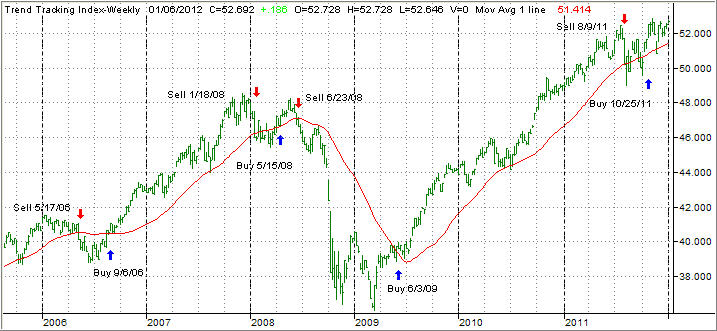
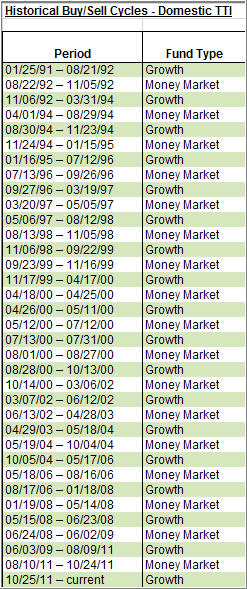
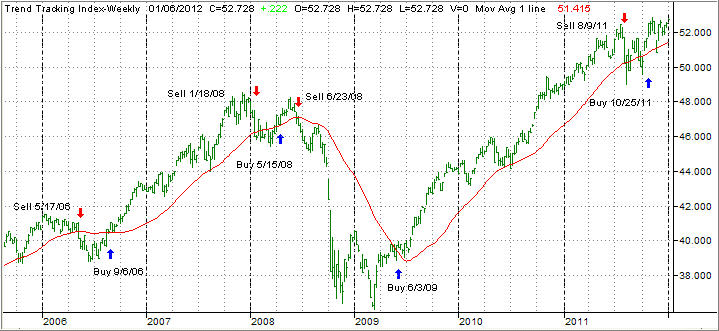
The domestic TTI broke through its long-term trend line generating a Sell for this area effective 8/9/2011. Over the recent past, we’ve seen the TTI hovering slightly below and above this dividing line between bullish and bearish territory. The clear break to the upside occurred on 10/24/11 and, effective 10/25/11, a new Buy signal for domestic equities is in effect.

As of today, our Trend Tracking Index (TTI—green line in above chart) has broken above its long term trend line (red) by +2.61%. Be sure to tune into my blog for the latest updates.

Read More

Still No Clear Direction For ETFs

Ulli Market Review Contact

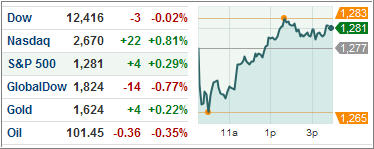
[Chart courtesy of MarketWatch.com]

Once again, major market ETFs didn’t move much as the S&P 500 gained 0.29%. But European indices fell once more while the Euro dropped to $1.28/Euro, its lowest level in 15 months.

While markets may not be fully incorporating European uncertainty at the moment, the weak Euro clearly indicates European concern among investors.

Although the VIX is relatively low just above 20, it’s no time to regain a risk appetite and move heavily into equity ETFs with the exception of a very select few. Volatility surely hasn’t faded away.

Widening European bond spreads also show continued financial strain in the region. Italy’s 10-year yield rose above the unsustainable 7% level to 7.07% while Spain’s 10-year yield went up to 5.59%. As borrowing costs remain high, confidence has greatly eroded. One thing’s for sure – I have little confidence that Europe can find a long-term solution without significant outside intervention.

Read More

01-05-2012

Ulli Newsletter Archives Contact

The ETF/No Load Fund Tracker—Monthly Review—December 30, 2011

ETFs Don’t Know Where To Turn

As the holiday season approached, markets were relatively inactive in the last week or so. The S&P 500 gained 0.85% in December although ending flat for the year. However, there wasn’t clear direction in market movements as broad indices swung up and down with no real discernible pattern. The S&P 500 is above its 50-day Moving Average, but that can quickly change.

The underlying current determining investor sentiment continues to be Europe. The Euro dropped to an 11-month low against the dollar, hitting $1.29/Euro at one point. Also, the month of December witnessed a litany of ratings downgrade warnings due to deteriorating finances and burgeoning debt loads. Leading the pack are Italy and Spain, which still not only have higher borrowing costs approaching 7%, but can’t seem to impose enough austerity to balance their budgets, further hurting their economic prospects.

In a drawn out tragedy, Greece still can’t come to compromise with creditors over the extent of the bond haircut or agree to additional bailout conditions, putting its Eurozone survival in great jeopardy. We should err on the safe side and place a high probability on a Greek exit that could rattle markets. Thus, we have positioned ourselves by keeping a low risk portfolio.

Nevertheless, we are sticking to selective buys on equity/sector ETFs with the exception of international equity ETFs and bear market funds. With the International TTI (Trend Tracking Index) finishing December at -7.65%, the international investment space is fraught with significant volatility. In this uncertain environment, we are keeping a majority bond ETF position and cash.

On home turf, the Domestic TTI finished the month above its long-term trend line at +2.33% as the chart below shows:

Thus, we still want to retain some minimal equity ETF exposure. Our go-to ETF for this has been Consumer Staples Select SPDR (XLP), which isn’t as susceptible to overall market volatility.

With all eyes on Europe, the uphill battle hasn’t gone away. Although the ECB instituted 3-year LTROs (Long Term Refinancing Options) to inject liquidity into a borderline insolvent banking system, this is merely a short-term solution. European banks are still hesitant to lend as they worry about counterparties fulfilling their loan obligations. In the end, the real economy has to bear the cost as funds meant to spur the economy aren’t channeled out.

Looking at the big picture, talks of a reformed EU treaty have further strained inter-European relations. Disagreements over deficit reduction conditions as well as how much autonomy countries can have over their own financial affairs has caused a rift questioning whether the Eurozone can maintain unity.

Asia’s economic condition is also deteriorating. China must come to the realization that it can’t grow its economy solely on the back of exports. Meanwhile, Japan’s strong Yen has made economic expansion via exports difficult while its domestic demand has been anemic.

In the U.S., December wasn’t a groundbreaking month other than wondering if the Fed will go ahead and enact QE3. Otherwise, investors kept flocking to Treasuries/bonds as global uncertainty remains elevated. The U.S. economic situation hasn’t truly improved, but the bleak overseas picture is enough for investors to seek refuge in U.S. government securities.

While markets slightly edged up in December, I don’t envision a breakout to the upside any time soon. Overall economic fundamentals suggest that we’re in for a long-haul with bulls and bears engaged in a continued tug-of-war.

As 2012 has kicked off, my advice is to continue adhering to a bond ETF tilted portfolio with strict stop loss protection in the event of a major market slide.